
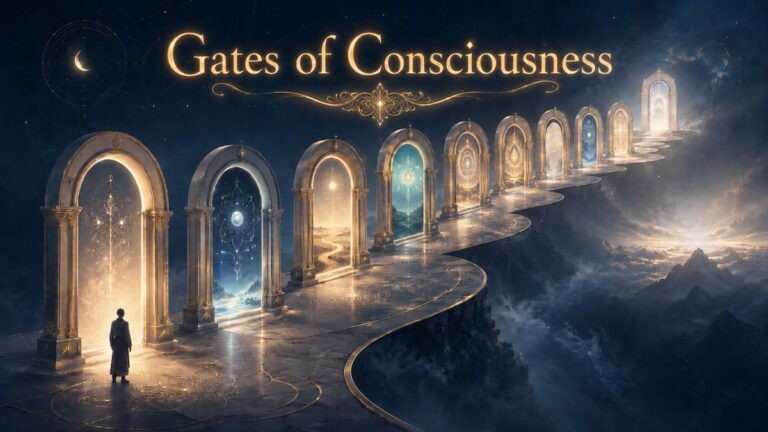
The Gates of Consciousness
The Gates of Consciousness.An Analysis of the Nine Gates of Awareness
A Psychological and Social Analysis of the Nine Gates of
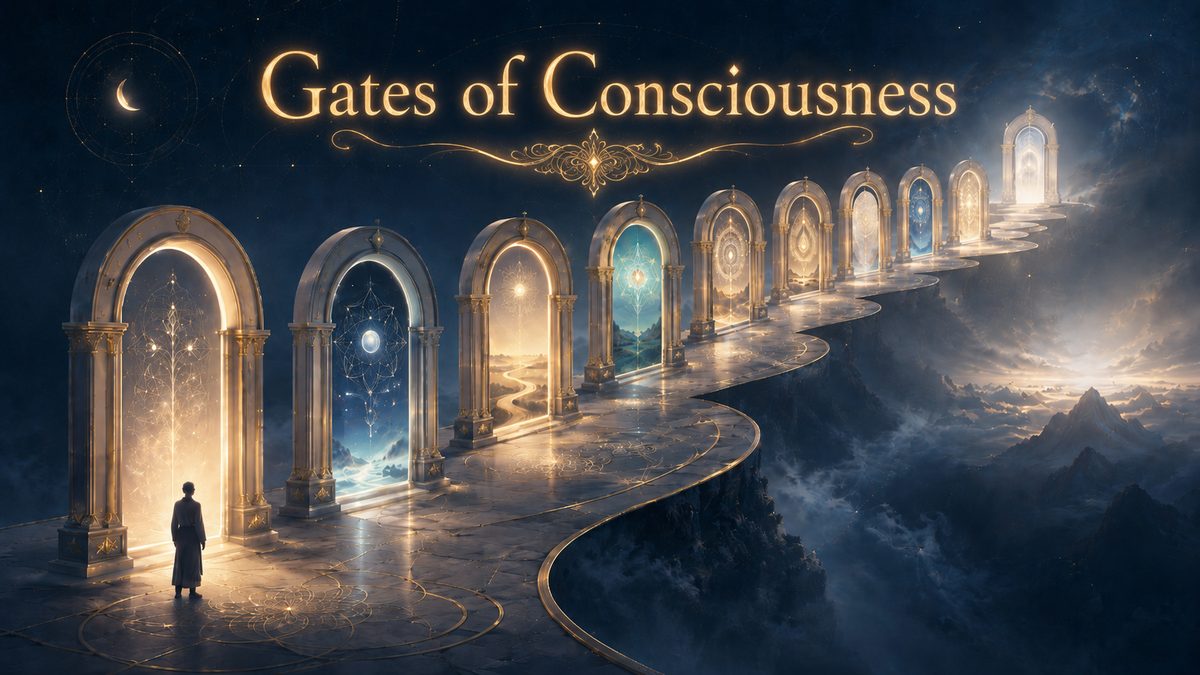
A Model for the Transition from Reactive Living to Conscious Living
Autor:Soheila.Dadkhah
Abstract
The Gates of Consciousness in the Seromi System constitute a stage-based model for understanding the processes of human growth, awakening, and inner reconstruction. Within this model, consciousness does not merely refer to knowledge, positive thinking, or temporary spiritual experiences. Rather, it is understood as a process through which individuals reconstruct their relationship with the body, emotions, mind, identity, language, choice, and meaning.
Each gate represents a point of transition: a threshold at which a person begins to move beyond an old, reactive, and unconscious pattern and enters a new level of presence, responsibility, and understanding.
This article examines the Gates of Consciousness not as a repetition of familiar concepts in personal development, but as an inner architecture for human transformation. This architecture enters into dialogue with several established approaches in developmental psychology, transformative learning, embodied cognition, mindfulness, and theories of behavioural change.
Keywords
Gates of Consciousness, Seromi System, human development, consciousness, inner transformation, conscious living, embodied cognition, transformative learning, meaning, identity, emotion, self-awareness, behavioural change
Introduction
In recent years, the term “consciousness” has been widely used in the fields of personal development, applied psychology, contemporary spirituality, and coaching. However, the widespread use of the term has sometimes made its meaning vague, general, and repetitive.
Many texts equate consciousness with knowledge, awakening, positive thinking, present-moment awareness, or emotional recognition. Yet they rarely explain how consciousness is formed in human life, how it becomes stable, and how it can move from the level of thought into behaviour, choice, and identity.
In the Seromi System, consciousness is not regarded as a static concept. It is a living and developmental process through which a person gradually moves beyond reactive, fragmented, and repetitive living toward a more conscious, creative, and meaningful way of being.
From this perspective, people do not change simply by acquiring more information. Many individuals already know what would be better for them, yet continue to repeat the same old patterns. Therefore, the central issue is not merely knowledge. The real question is how knowledge can be transformed into experience, choice, behaviour, and presence.
The Gates of Consciousness were developed within this system in response to this question. Each gate is an inner threshold—a point at which the individual encounters a fundamental question and is required to reconsider part of their relationship with the self, emotions, truth, meaning, and the world.
Passing through a gate is not simply an intellectual understanding of a concept. It involves a transformation in the way a person sees, feels, chooses, and lives.
This article represents the first step in introducing the Gates of Consciousness within the Seromi System. Its purpose is to present an initial framework showing that these gates are not merely poetic metaphors or familiar ideas borrowed from the language of personal development. They may instead be examined as a map of human transformation, self-awareness, and the reconstruction of meaning.
Guiding Questions
This article is structured around several central questions:
1. What does consciousness actually mean in human life?
2. Is consciousness merely a form of knowing, or does it become real only when knowledge is transformed into experience, choice, and behaviour?
3. Why do many people continue to remain within old patterns and repetitive reactions despite possessing intellectual awareness?
4. What is the difference between a superficial change in behaviour and a profound transformation in identity, emotion, and meaning?
5. What roles do the body, emotions, mind, and language play in the development of consciousness?
6. Why can the process of human growth be understood as a stage-based or gate-based journey?
7. Which dimension of human consciousness is activated by each gate in the Seromi System?
8. How does a person move from reactive living to conscious living?
9. Why does consciousness remain incomplete without responsibility, choice, and sustained presence?
10. How do the Gates of Consciousness differ from repetitive and conventional concepts within personal development?
Consciousness Beyond Knowledge
One of the most common errors in understanding consciousness is to equate it with knowledge.
A person may possess extensive knowledge about their fears, emotional wounds, behavioural patterns, and even the possible roots of their difficulties, while continuing to live within the same old cycles. This indicates that intellectual awareness alone is insufficient for transformation.
Within the Seromi System, consciousness becomes meaningful when knowledge is transformed into inner experience, conscious choice, and a change in one’s way of living.
For this reason, consciousness is not regarded as a purely cognitive stage. It is a multilayered process. A person must understand, feel, observe, choose, express, and eventually embody what has been learned in everyday life.
From this perspective, consciousness does not occur only within the mind. It is connected to the body, emotions, language, memory, relationships, decisions, and meaning.
A person becomes more conscious when greater coherence is created between what they know, what they feel, what they express, and what they actually live.
Why the Term “Gate”?
Within this system, the word “gate” is not merely a decorative metaphor. A gate represents a point of transition—a threshold at which a person can no longer continue exactly as before.
Each gate marks the boundary between an old level of consciousness and a new level of understanding and presence.
In everyday life, people often become trapped in repetitive patterns. One person may repeatedly make decisions from fear. Another may continually perceive themselves as a victim of circumstances. Someone else may ignore their emotions, while another may conceal their inner truth in order to gain acceptance from others.
In such conditions, the individual is not fully living; they are primarily reacting.
A gate emerges when the old pattern can no longer continue in the same way. The person recognises that something must be seen, accepted, released, or chosen differently.
Therefore, each gate represents a form of encounter—an encounter with a part of the self that has previously remained hidden, suppressed, denied, or unconscious.
The Gates of Consciousness as an Architecture of Human Transformation
Within the Seromi System, the Gates of Consciousness may be understood as a form of inner architecture.
The term “architecture” does not refer to a rigid or closed structure. Rather, it refers to a map showing how a person may move from more elementary forms of self-awareness toward deeper levels of presence and meaning.
This model does not reduce human growth to behavioural change alone.
Many behavioural approaches focus on how individuals can modify their habits, make better decisions, or improve their performance. These goals are important, but they are not always sufficient.
At times, a person’s behaviour remains unchanged because its roots exist at a deeper level—in identity, fear, emotion, meaning, or the person’s internal image of the self.
The Gates of Consciousness attempt to include these deeper layers.
For this reason, each gate is not merely an exercise or a technique. It represents a stage in the reconstruction of a person’s relationship with themselves.
This reconstruction may occur at the level of the body, emotion, mind, language, meaning, choice, and the individual’s relationship with the world.
The Three Main Dimensions of Each Gate
Each gate within the Seromi System contains three principal dimensions:
1. The Cognitive Dimension
At this level, the individual becomes aware of the pattern in which they are trapped.
They begin to recognise repetitions, reactions, beliefs, and internal narratives that shape their life. This stage marks the beginning of observation.
2. The Emotional Dimension
At this level, the person encounters emotions that may have been ignored, suppressed, or concealed for many years.
They begin to understand that emotion is not the enemy of consciousness, but an important source of information about their inner world.
3. The Existential Dimension
At this level, the questions become deeper.
The individual no longer asks only, “What behaviour do I have?” but also:
“Who have I become?”
“What am I actually living?”
“What meaning have I given to myself and the world?”
“Does this path reflect my truth?”
For this reason, passing through the gates is not merely a superficial change. Each gate may reconstruct part of a person’s identity, meaning, and way of being in the world.
The General Path of the Gates
In the Seromi System, the journey of consciousness begins with a fundamental point: “I Am.”
This point represents the individual’s return to the recognition of their own existence.
Before people can fully understand their emotions, desires, or purpose, they may first need to recognise their own being again.
This means gradually moving beyond a life defined solely by roles, fears, external expectations, and the definitions imposed by others, and returning to the simple yet profound statement: “I Am.”
The path then moves into further layers: feeling, creating, maintaining stability, expressing truth, seeing, understanding, awakening, and eventually experiencing connection with the totality of life.
These stages are not necessarily linear, nor are they completed once and for all.
A person may return to the same gate many times and experience it at a deeper level on each occasion.
For example, an individual may learn to recognise their emotions during one period of life, but encounter a deeper emotional layer years later under different circumstances.
Similarly, a person may express their truth in one area while still needing to pass through the same gate within relationships, work, family, or their spiritual path.
The gates are therefore not rigid and fixed steps. They are recurring fields of growth.
Each time a person becomes more conscious, the same gates may reveal a new dimension of meaning.
Frequently Asked Questions About the Gates of Consciousness
1. What are the Gates of Consciousness?
The Gates of Consciousness are stages through which a person moves from reactive and unconscious patterns toward deeper levels of awareness, choice, presence, and meaning.
2. Why is the term “gate” used?
Because each gate represents a point of transition—a moment when a person can no longer continue with the same previous patterns and must experience a new way of seeing, feeling, or choosing.
3. Are the Gates of Consciousness purely spiritual concepts?
No. These gates are connected to the body, emotions, mind, behaviour, language, identity, choice, and the meaning of life. They are not limited to spiritual experiences.
4. What does consciousness mean in the Seromi System?
In this system, consciousness is not merely knowledge. Consciousness develops when knowledge is transformed into experience, behaviour, choice, responsibility, and a way of living.
5. What is the difference between intellectual awareness and lived awareness?
Intellectual awareness means that a person has information about a subject. Lived awareness means that this knowledge has created a real effect on their emotions, decisions, behaviour, and daily life.
6. What is the main purpose of the Gates of Consciousness?
Their main purpose is to help individuals move beyond reactive living and toward a more conscious, responsible, and meaningful way of life.
7. What does reactive living mean?
Reactive living means making decisions primarily on the basis of fear, habit, past wounds, anger, guilt, or the need for approval, rather than through conscious choice.
8. What does conscious living mean?
Conscious living means being able to recognise one’s emotions, needs, patterns, and the possible consequences of a decision before reacting, and then making a more responsible choice.
9. Are the Gates of Consciousness experienced in a fixed sequence?
The gates follow a general path, but the journey is not completely linear. A person may return to the same gate many times and experience it at a deeper level on each occasion.
10. What is the first Gate of Consciousness?
The first gate is “I Am.” It represents the moment when a person recognises their own existence and presence and begins to move beyond identities defined entirely by others.
11. Why are emotions important in this system?
Because emotions contain valuable information about a person’s inner world. They can reveal needs, fears, boundaries, wounds, and desires that the mind alone may not be able to identify.
12. What role does the body play in the path of consciousness?
Many human reactions first appear in the body as contraction, anxiety, restlessness, calmness, or resistance. Paying attention to the body helps individuals recognise their inner signals earlier and more accurately.
13. What dimensions does each gate contain?
Each gate has three principal dimensions: a cognitive dimension for recognising patterns, an emotional dimension for understanding inner experiences, and an existential dimension for reconstructing identity and meaning.
14. How do the Gates of Consciousness differ from conventional personal development?
This model does not stop at motivational statements such as “think positively” or “be yourself.” It examines how a person actually moves beyond an old pattern and creates real change in life.
15. Is recognising a pattern enough to change it?
No. Recognition is the beginning of the process. Change becomes more stable when the person can also transform the pattern within emotions, behaviour, choices, and relationships.
16. Why is language important in the path of consciousness?
Because the way a person speaks about themselves, their emotions, suffering, and desires forms part of the structure of their identity.
17. What does expressing truth mean in this system?
Expressing truth means bringing a person’s external language into alignment with their inner awareness. It does not mean saying everything without considering context or consequences.
18. Is passing through a gate always easy?
No. Each gate may bring a person into contact with fears, old beliefs, suppressed emotions, or parts of their identity that they have previously avoided.
19. How can we know that we have passed through a gate?
When a new understanding no longer remains only in the mind and becomes visible in choices, behaviour, boundaries, relationships, and daily life, the process of passing through the gate has begun.
20. Is passing through the gates a once-and-for-all process?
No. Human growth has no fixed final point. The same gate may present a new meaning or challenge during different periods of life.
21. What is the final outcome of this path?
The outcome is not becoming a perfect or error-free person. It is the development of a more conscious, honest, and responsible relationship with oneself, others, and life.
22. What is the article’s central idea in one sentence?
The Gates of Consciousness provide a map for moving from unconscious reactions toward presence, choice, responsibility, and a more meaningful way of living.
________________________________________
The Difference Between the Gates of Consciousness and Conventional Personal Development Concepts
One of the most important aspects of introducing this model is clarifying how it differs from repetitive personal development language.
In many popular texts, human growth is reduced to a small number of familiar recommendations:
Think positively.
Love yourself.
Let go of the past.
Live in the present moment.
Become the best version of yourself.
Such statements may be inspiring, but they often fail to explain how an individual is actually expected to change internally.
The Gates of Consciousness in the Seromi System do not simply offer slogans. They attempt to describe the process of transition.
Instead of merely saying, “Be yourself,” the model asks:
Which part of you remains hidden beneath fear, shame, habit, or the expectations of others?
Instead of saying, “Accept your emotions,” it examines how emotion appears within the body, decision-making, relationships, and meaning.
Instead of saying, “Be conscious,” it asks:
At which level has your awareness not yet been transformed into behaviour and choice?
For this reason, the model is not exclusively motivational, spiritual, or psychological.
The Gates of Consciousness create a bridge between lived experience, developmental psychology, meaning, language, and human responsibility.
________________________________________
Reactive Living and Conscious Living
One of the central distinctions within this model is the difference between reactive living and conscious living.
Reactive living occurs when a person repeats old responses more often than they make genuine choices.
They may make decisions from fear, anger, the need for approval, guilt, or unresolved wounds from the past.
In this state, the individual may believe that they are choosing freely, while many of their decisions are actually produced by unconscious patterns.
Conscious living means that a person becomes able to observe themselves before reacting.
They become capable of recognising what they feel, understanding their actual needs, taking responsibility for their decisions, and choosing from a deeper level of awareness.
In this state, a person does not become perfect or incapable of error. Rather, their relationship with themselves and with life becomes more mature.
The Gates of Consciousness represent a movement from reaction toward presence.
Each gate brings one part of the individual out of automatic functioning and into the field of conscious choice.
________________________________________
The Body, Emotion, and Meaning in the Path of Consciousness
One of the important principles of the Seromi System is that consciousness does not occur only in the mind.
The body and emotions play a fundamental role in how individuals understand themselves and the world.
Many human reactions appear first in the body and emotions before they become clear thoughts:
contraction,
anxiety,
heaviness,
restlessness,
enthusiasm,
fear,
calmness,
or resistance.
When an individual works only with the mind while ignoring the body and emotions, their consciousness remains incomplete.
For this reason, the Gates of Consciousness attempt to move human development beyond the intellectual level and closer to the full experience of being human.
Within this model, emotion is neither weakness nor interference. It is a meaningful source of information about the individual’s inner world.
Meaning also plays a central role.
Human beings are not merely behavioural organisms who change through reward and punishment. They are meaning-making beings.
They create narratives from their experiences, assign meaning to suffering, imagine possible futures, and live according to these meanings.
Therefore, lasting change occurs when a person’s inner structure of meaning is also reconstructed.
________________________________________
Language and the Expression of Truth
The gate concerned with the expression of truth is one of the important stages in the journey of consciousness.
As long as a person is unable to express their truth, part of their consciousness remains trapped within silence, fear, or external adaptation.
The expression of truth does not mean saying everything to everyone in any manner. It means bringing language into greater alignment with inner awareness.
Language is not merely a tool of communication. It also shapes human identity.
The way people speak about themselves, narrate their suffering, express their needs, and define their boundaries forms part of the structure of their consciousness.
From this perspective, expressing truth is not a superficial act.
When people express their truth, they do not merely speak a sentence. They redefine their position in relation to themselves, others, and the world.
________________________________________
Conclusion
The Gates of Consciousness in the Seromi System offer a model for understanding the path of human growth and transformation.
This model regards consciousness not as a vague idea or a spiritual slogan, but as a stage-based and experiential process that can be examined through the realities of human life.
Within this process, the individual moves beyond knowledge alone and toward experience, choice, expression, responsibility, and meaning.
Each gate represents a point of encounter and transition.
At every stage, the individual comes into contact with a part of the self that must be seen, accepted, released, or reconstructed.
For this reason, the gates are not merely mental stages. They form part of the inner architecture of the human being.
The primary difference between this model and many conventional approaches to personal development is that it does not stop at general slogans.
It examines how consciousness appears within the body, emotions, mind, language, choice, identity, and meaning, and how it can move from intellectual understanding into lived reality.
The Gates of Consciousness in the Seromi System may therefore be defined as a map for the transition from reactive living to conscious living—a path toward returning to the authentic self, reconstructing one’s relationship with life, and moving from fragmentation toward meaning.
________________________________________
References
Bandura, A. (1977). Self-efficacy: Toward a unifying theory of behavioural change. Psychological Review, 84(2), 191–215.
Brown, K. W., & Ryan, R. M. (2003). The benefits of being present: Mindfulness and its role in psychological well-being. Journal of Personality and Social Psychology, 84(4), 822–848.
Damasio, A. R. (1994). Descartes’ Error: Emotion, Reason, and the Human Brain. G. P. Putnam’s Sons.
Kabat-Zinn, J. (2003). Mindfulness-based interventions in context: Past, present, and future. Clinical Psychology: Science and Practice, 10(2), 144–156.
Kegan, R. (1982). The Evolving Self: Problem and Process in Human Development. Harvard University Press.
Kegan, R. (1994). In Over Our Heads: The Mental Demands of Modern Life. Harvard University Press.
Mezirow, J. (1978). Perspective transformation. Adult Education, 28(2), 100–110.
Neff, K. D. (2003). Self-compassion: An alternative conceptualisation of a healthy attitude toward oneself. Self and Identity, 2(2), 85–101.
Prochaska, J. O., & DiClemente, C. C. (1983). Stages and processes of self-change of smoking: Toward an integrative model of change. Journal of Consulting and Clinical Psychology, 51(3), 390–395.
Ryan, R. M., & Deci, E. L. (2000). Self-determination theory and the facilitation of intrinsic motivation, social development, and well-being. American Psychologist, 55(1), 68–78.
Varela, F. J., Thompson, E., & Rosch, E. (1991). The Embodied Mind: Cognitive Science and Human Experience. MIT Press.
A Psychological and Social Analysis of the Nine Gates of
Gate Nine. I Live My Presence Author: Soheila Dadkhah Abstract
Gate Eight. I Love Myself Author: Soheila Dadkhah Abstract The