
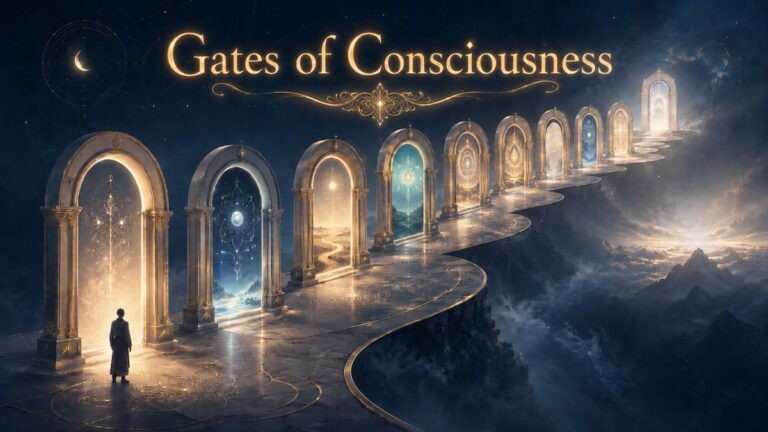
The Gates of Consciousness
The Gates of Consciousness.An Analysis of the Nine Gates of Awareness
A Psychological and Social Analysis of the Nine Gates of
The First Gate of Consciousness
Autor:Soheila,.Dadkhah
“I Am”
Reconstructing the Sense of Existence, Identity, and the Right to Be Present in Life
Abstract
The “I Am” Gate is the first stage in the architecture of the Gates of Consciousness within the Seromi System. This gate addresses a simple yet fundamental question: does a person genuinely experience their own presence, or do they merely live through roles, duties, fears, and the expectations of others?
Within this framework, “I Am” is not an affirmation, a claim of superiority, or an invitation to excessive self-focus. It refers to the human capacity to recognise and acknowledge one’s own existence—an existence that precedes occupation, social position, relationships, achievements, failures, and external definitions.
Many people can provide extensive information about themselves while lacking a stable connection with their sense of being, agency, boundaries, and authentic desires. The first gate seeks to distinguish between existence, identity, and role. It proposes that before a person can feel, create, or express truth, conscious development requires an initial centre: a person who can say “I Am” and take responsibility for their own presence.
This article examines the cognitive, emotional, bodily, linguistic, and existential dimensions of this gate. It also proposes criteria for distinguishing genuine presence from the mere repetition of an affirmation.
Keywords
I Am Gate, Gates of Consciousness, Seromi System, sense of existence, identity, presence, self-awareness, personal boundaries, reactive living, agency, identity reconstruction, authentic self
________________________________________
Introduction
Before a person asks, “What am I feeling?”, “What do I want?”, “What should I create?” or “What is my truth?”, a more fundamental question must first be addressed:
Do I recognise my own presence independently of all the roles and definitions I have assumed?
At first glance, the answer may appear obvious. Every person knows that they exist. They know their name, remember their past, and can speak about their characteristics, relationships, and activities. However, knowing that “I exist” is not the same as consciously experiencing “I Am.”
A person may be physically present while living psychologically and meaningfully in constant reaction to others. They may spend years making decisions, working, forming relationships, and accepting responsibilities without asking which parts of that life were genuinely chosen by them.
A person may know themselves almost entirely through their roles:
I am a mother.
I am a partner.
I am a manager.
I am a therapist.
I am a successful or unsuccessful person.
I am someone whom others need.
These descriptions are not necessarily false. The difficulty begins when role replaces existence—when a person no longer knows who they are without their duties, relationships, social approval, and titles.
The “I Am” Gate is a point of return to this primary layer. It does not ask what a person has achieved. It asks:
Have you allowed yourself to exist before your achievements and roles?
________________________________________
Guiding Questions
This article is structured around several central questions:
1. What is the difference between existing and experiencing one’s own presence?
2. Is human identity merely a collection of roles and characteristics, or is there a deeper layer that precedes them?
3. How can a person be present within their own life while remaining disconnected from their inner centre?
4. What is the relationship between “I Am,” personal boundaries, and the capacity to choose?
5. Why do some people depend on success, sacrifice, approval, or usefulness in order to justify their right to be present?
6. Is repeating the phrase “I Am” sufficient for passing through this gate?
7. How can we recognise when the sense of existence has moved beyond intellectual understanding and become a lived experience?
________________________________________
What “I Am” Does Not Mean
To understand this gate, several common misunderstandings must first be clarified.
“I Am” does not mean being superior to others.
It does not mean ignoring relationships or responsibilities.
It does not mean selfishness, self-centredness, or complete independence from others.
Nor does it mean creating an exaggerated image of oneself as permanently strong or powerful.
The first gate does not tell people to think only about themselves. It proposes that in order to form a healthy relationship with others, individuals must first recognise their own position within that relationship.
A person without an independent sense of presence may confuse love with self-erasure, responsibility with self-sacrifice, and adaptation with genuine choice.
Under such conditions, a relationship is no longer formed between two distinct people. It is formed between one person and another who has hidden or removed parts of themselves in order to preserve the connection.
“I Am” is therefore not a declaration of superiority. It is a declaration of presence.
________________________________________
The Difference Between Existence, Identity, and Role
One of the central distinctions within the first gate is the difference between three concepts.
Existence
Existence is the most fundamental level. Before a person has an occupation, title, achievement, or personal narrative, they are present. At this level, the value of existence is not dependent on performance.
Identity
Identity is a structure formed through experience, beliefs, relationships, memories, and choices. It is not fixed or unchangeable. It can be examined, revised, and reconstructed.
Role
A role is a position assumed within a relationship or social structure, such as parent, partner, teacher, therapist, manager, or friend.
Difficulty arises when a role becomes the whole of identity, and identity then replaces the primary reality of existence.
A person who derives all meaning from a particular role may feel that they themselves have disappeared when that role changes or ends. The end of a relationship, retirement, migration, a career change, children becoming independent, or the loss of social status may therefore become more than an external change. It may destabilise the person’s entire identity structure.
The “I Am” Gate helps individuals differentiate between these three levels:
I live through my roles, but I am not only my roles.
I have an identity, but my identity can continue to develop.
Before all of these, I am present.
________________________________________
How Does a Person Lose the Sense of Being?
The sense of existence does not usually disappear in a single moment. It may gradually become hidden beneath layers of adaptation, fear, dependency, and obligation.
From childhood, people learn which parts of themselves they may express and which parts must be hidden in order to preserve connection. A child may have received affection primarily when they were quiet, successful, obedient, useful, strong, or undemanding.
Under these conditions, an implicit message may develop:
“My existence alone is not enough. I must provide something in order to earn the right to be present.”
In adulthood, this message may appear in many forms:
A person feels valuable only when they are useful.
They fear disagreement because they experience it as a threat to the relationship.
They quickly recognise the needs of others but cannot identify their own desires.
They conceal their true emotions in order to preserve an acceptable image.
When they stop working, caring for others, or producing, they experience emptiness or guilt.
In all these situations, the individual exists, but their right to exist has become conditional.
The first gate brings these conditions into awareness.
________________________________________
“I Am” and the Right to Be Present
The right to be present means that a person does not have to continually prove their worth in order to exist, speak, feel, or maintain boundaries.
This does not mean that every behaviour or desire is automatically valid. Human existence may be unconditional, but behaviour still requires responsibility, reflection, and ethical evaluation.
There is an important difference between the following two statements:
“Because I exist, everything I do is right.”
and:
“Even when I make a mistake, my existence is not erased. I remain responsible for recognising and correcting my behaviour.”
The “I Am” Gate separates the value of existence from the evaluation of behaviour.
This distinction is essential because people who interpret mistakes as proof of personal worthlessness often defend or deny their mistakes instead of taking responsibility for them.
Recognising one’s existence does not reduce responsibility. It increases the capacity to accept responsibility without psychological annihilation.
________________________________________
The Cognitive Dimension of the “I Am” Gate
Within the cognitive dimension, the individual begins to identify the narratives through which their identity has been organised.
They may ask:
How do I define myself?
Which definitions have I consciously chosen, and which have been given to me by others?
Have I connected my worth to success, relationships, approval, or sacrifice?
If my central roles disappeared, what would remain of my sense of identity?
Do my decisions arise from authentic desire, or from fear of rejection?
The aim of this stage is not simply to replace negative descriptions with more positive ones. If a person only substitutes positive labels for negative labels, they remain dependent on labels.
Cognitive transition begins when a person can observe:
“This narrative has been formed about me, but it is not the entirety of my existence.”
At this point, a distinction begins to emerge between the observer and the narrative being observed.
________________________________________
The Emotional Dimension of the “I Am” Gate
Returning to presence is not always calm or pleasant.
When individuals begin to move beyond old roles and patterns of adaptation, they may encounter emotions that were previously hidden beneath constant activity and responsibility.
Fear of abandonment, shame, suppressed anger, grief, worthlessness, or guilt may come to the surface.
For example, a person who has always been strong for others may feel guilty when paying attention to their own needs. Someone whose identity depends on pleasing others may interpret every boundary as selfishness.
The first gate does not ask individuals to eliminate these emotions. It asks them to understand that genuine presence may initially reveal the structures that were developed to conceal the absence of presence.
At this stage, the central question is not:
“How can I immediately feel better?”
It is:
“What does this emotion reveal about my relationship with my right to be present?”
________________________________________
The Bodily Dimension: How the Body Carries “I Am”
The sense of presence is not only an intellectual concept. Human beings also experience their existence through the body.
Posture, breathing, the ability to occupy space, eye contact, tone of voice, speed of response, and bodily reactions to disagreement can all provide information about a person’s relationship with their own presence.
Someone may lower their voice when speaking about a personal need. Another person may anticipate the other’s needs before they have even finished speaking and immediately abandon their own. Someone else may experience intense bodily contraction or agitation when expressing disagreement.
These signs do not by themselves constitute a psychological diagnosis. However, they may help individuals recognise how the right to be present is experienced within their body.
The “I Am” Gate asks a person not only to define presence, but also to observe how presence is embodied.
________________________________________
“I Am” and Personal Boundaries
A boundary becomes meaningful only when “self” and “other” can be distinguished.
When individuals cannot identify what belongs to them, it becomes difficult to distinguish their own desires, responsibilities, feelings, and choices from those of others.
A healthy boundary makes it possible to say:
This is my feeling, and that is yours.
This is my responsibility, and that is yours.
I can understand you without becoming identical to you.
I can disagree without destroying the relationship.
I can love you without erasing myself.
The first gate forms the basis of all later boundary work.
A person who does not recognise their own presence may struggle to maintain boundaries because every “no” feels like a threat to belonging.
Within this model, saying “no” is not always a sign of awareness, just as saying “yes” is not always a sign of weakness. The essential question is whether the response arises from conscious choice or from fear.
________________________________________
“I Am” and Agency
Agency is the capacity to recognise oneself not merely as a passive receiver of events, but as a participant who can influence, choose, and respond.
Agency is different from having total control over life.
No person has complete control over circumstances, the past, the body, society, or the behaviour of others. Yet even within limitation, part of the human response may remain open to choice.
The “I Am” Gate creates distance from two opposite extremes.
In the first extreme, the individual experiences themselves entirely as a victim and recognises no role for their own choices.
In the second, the individual believes they must control everything and interprets every difficulty as proof of personal weakness or failure.
Conscious presence offers a more balanced position:
I did not create every event in my life, but I can reconsider my relationship with what has happened and, within the limits of my capacity, create a new response.
Agency begins from this point.
________________________________________
Why Repeating “I Am” Is Not Enough
Affirmations can temporarily direct attention, but repeating a sentence does not by itself constitute passing through a gate.
A person may say “I Am” many times each day while still:
waiting for approval before making every decision;
feeling ashamed of expressing personal needs;
losing their entire identity when a relationship changes;
deriving all self-worth from performance;
or collapsing in response to disagreement.
In such cases, the sentence exists within language, but has not yet become established within the structure of life.
The gate becomes active when “I Am” becomes a genuine question:
How am I present?
Where do I remove myself from my own life?
What conditions have I placed upon my right to exist?
Who do I become when I am no longer required to perform my familiar role?
Transition begins when the answers enter behaviour and choice.
________________________________________
Signs That the First Gate Has Been Activated
Passing through this gate is not a final or magical event, but certain changes may gradually become observable.
The individual begins to distinguish between role and identity.
They can express their own desires without humiliating or dismissing the desires of others.
They can experience disagreement without interpreting it as total personal destruction.
They no longer connect their entire value to usefulness or achievement.
They can say “I do not know” without experiencing identity collapse.
They remain present within relationships without becoming completely absorbed by them.
They accept responsibility for their actions without equating mistakes with worthlessness.
They can rest, remain silent, or temporarily step away from a role while continuing to experience themselves as existing.
These signs do not indicate the end of the process. They suggest that an initial centre of presence is beginning to form.
________________________________________
Possible Distortions Within This Gate
Every concept of transformation can also be used defensively or performatively.
One distortion is turning “I Am” into a claim of superiority. The individual may assume that awareness permits them to ignore the needs and boundaries of others.
Another distortion is constructing a new identity around being “an aware person.” In this case, the language of awareness becomes a means of proving difference or superiority.
A third distortion is withdrawal from relational and social reality, as though returning to the self requires total independence from connection, responsibility, or feedback.
Authentic presence neither dissolves the individual into the other nor separates the individual completely from the other.
The balanced formulation of this gate is:
I am, and you are also.
My presence does not erase yours.
A healthy relationship begins where neither person must disappear in order for the other to exist.
________________________________________
The Relationship Between the First Gate and the Later Gates
“I Am” is the foundation of the pathway because without a sense of existence, the later gates may easily become distorted.
Without “I Am,” emotions may become only reactions to others.
Without “I Am,” creativity may become an attempt to prove personal worth.
Without “I Am,” stability may be confused with rigidity and resistance.
Without “I Am,” expressing truth may either be suppressed or become aggression.
Without “I Am,” seeing and understanding may remain organised around external expectations.
The first gate does not provide all the answers. It establishes a point to which later answers can return.
________________________________________
Conclusion
Within the Seromi System, the “I Am” Gate represents a return to the most basic and profound reality of human life: presence.
This gate does not ask individuals to create a new and flawless identity. It asks them to recognise that before roles, achievements, failures, duties, and judgements, they exist.
“I Am” does not mean selfishness. It means refusing to erase oneself.
It does not mean controlling life completely. It means accepting one’s share of responsibility in responding to life.
It does not mean becoming independent of others. It means entering relationships as a distinct presence.
Passing through this gate begins when people no longer feel compelled to perform, sacrifice themselves, seek constant approval, or conceal their truth in order to justify their right to exist.
The final message of the first gate is not:
“I am more important than others.”
Its message is:
I, too, am present in this life.
My existence, before roles and achievements, is a reality that must be recognised, accepted, and lived responsibly.
________________________________________
Frequently Asked Questions About the First Gate: “I Am”
1. What is the “I Am” Gate?
It is the first stage in the Gates of Consciousness, in which a person recognises their existence and presence independently of roles, achievements, and external definitions.
2. Is “I Am” merely an affirmation?
No. Repeating the phrase may direct attention, but the gate begins to open only when its meaning becomes visible in choices, behaviour, boundaries, and daily life.
3. What is the difference between existing and experiencing presence?
Existence is a fact. Experiencing presence means recognising oneself, one’s needs, emotions, choices, and participation in life.
4. Why is “I Am” the first gate?
Because before a person can identify emotions, create, or express truth, there must be a centre capable of saying, “This experience, feeling, desire, and choice belongs to me.”
5. Does “I Am” mean selfishness?
No. Selfishness ignores the needs of others. “I Am” means that a person does not erase themselves in order to preserve a relationship.
6. What is the difference between existence, identity, and role?
Existence is the basic reality of being present. Identity develops through experience, belief, and narrative. A role is a position occupied within relationships or society.
7. Are human roles part of identity?
Yes, but they are not the whole of identity. Difficulty arises when a person can no longer experience their own value or existence without a particular role.
8. How does a person lose connection with their own presence?
Usually through prolonged adaptation, fear of rejection, dependence on approval, concealment of personal needs, and making self-worth conditional upon success or usefulness.
9. What does it mean to make the right to be present conditional?
It means believing that one deserves love, respect, or the right to exist only when one is successful, calm, self-sacrificing, useful, or approved by others.
10. Does accepting one’s existence mean considering all behaviour acceptable?
No. The value of existence and the evaluation of behaviour are different. A person can maintain their sense of worth while accepting responsibility for mistakes.
11. How is “I Am” connected to personal boundaries?
Healthy boundaries require a person to distinguish their own emotions, needs, and responsibilities from those of others.
12. Does setting boundaries mean distancing oneself from others?
No. Healthy boundaries do not end relationships. They allow two people to remain connected without erasing or absorbing one another.
13. Why is saying “no” difficult for some people?
Because they may associate disagreement with the loss of love, safety, or belonging. In such cases, saying “no” feels like a threat to existence within the relationship.
14. What does agency mean within this gate?
Agency means recognising that one does not create every event, but can often influence the nature of one’s response, choices, and direction.
15. Does “I Am” mean controlling everything?
No. Conscious presence differs from total control. A person acknowledges limitations while also recognising the part that remains open to choice.
16. What role does the body play in the “I Am” Gate?
The body may reveal how presence is experienced through breathing, posture, tone of voice, contraction during disagreement, and physical reactions to expressing needs.
17. Why can returning to oneself bring up difficult emotions?
Because when old roles and adaptations loosen, fear, anger, grief, shame, and previously hidden needs may become visible.
18. Is recognising old narratives enough to create change?
No. Recognition is the beginning. Change deepens when new understanding is reflected in decisions, relationships, boundaries, and behaviour.
19. How can we recognise excessive dependence on a role?
When the change or loss of that role causes a person to feel that their entire value, identity, or meaning has disappeared.
20. What are signs that this gate has been activated?
The ability to express needs, tolerate disagreement, accept responsibility, step away from roles temporarily, and maintain self-worth without constant proof.
21. Is the “I Am” Gate passed once and for all?
No. Changes in life may repeatedly bring a person back to questions of identity, value, role, and the right to be present.
22. What is the article’s central idea in one sentence?
The “I Am” Gate is the process through which a person learns not to erase themselves from life while also respecting the existence of others.
________________________________________
Position of the Academic Sources
The following sources do not directly present or prove the “I Am” Gate within the Seromi System. This model is an independent formulation.
These works were selected to support related concepts, including the dynamic self-concept, narrative identity, agency, autonomy, contingent self-worth, social acceptance, the embodied self, and alignment between personal goals and the self.
________________________________________
References
Bandura, A. (2001). Social cognitive theory: An agentic perspective. Annual Review of Psychology, 52, 1–26. https://doi.org/10.1146/annurev.psych.52.1.1
Braun, N., Debener, S., Spychala, N., Bongartz, E., Sörös, P., Müller, H. H. O., & Philipsen, A. (2018). The senses of agency and ownership: A review. Frontiers in Psychology, 9, Article 535. https://doi.org/10.3389/fpsyg.2018.00535
Crocker, J., & Wolfe, C. T. (2001). Contingencies of self-worth. Psychological Review, 108(3), 593–623. https://doi.org/10.1037/0033-295X.108.3.593
Leary, M. R., & Baumeister, R. F. (2000). The nature and function of self-esteem: Sociometer theory. Advances in Experimental Social Psychology, 32, 1–62. https://doi.org/10.1016/S0065-2601(00)80003-9
Markus, H., & Wurf, E. (1987). The dynamic self-concept: A social psychological perspective. Annual Review of Psychology, 38, 299–337. https://doi.org/10.1146/annurev.ps.38.020187.001503
McAdams, D. P., & McLean, K. C. (2013). Narrative identity. Current Directions in Psychological Science, 22(3), 233–238. https://doi.org/10.1177/0963721413475622
Rogers, C. R. (1959). A theory of therapy, personality, and interpersonal relationships, as developed in the client-centered framework. In S. Koch (Ed.), Psychology: A Study of a Science: Vol. 3. Formulations of the Person and the Social Context (pp. 184–256). McGraw-Hill.
Ryan, R. M., & Deci, E. L. (2000). Self-determination theory and the facilitation of intrinsic motivation, social development, and well-being. American Psychologist, 55(1), 68–78. https://doi.org/10.1037/0003-066X.55.1.68
Seth, A. K. (2013). Interoceptive inference, emotion, and the embodied self. Trends in Cognitive Sciences, 17(11), 565–573. https://doi.org/10.1016/j.tics.2013.09.007
Sheldon, K. M., & Elliot, A. J. (1999). Goal striving, need satisfaction, and longitudinal well-being: The self-concordance model. Journal of Personality and Social Psychology, 76(3), 482–497. https://doi.org/10.1037/0022-3514.76.3.482
Tsakiris, M. (2017). The multisensory basis of the self: From body to identity to others. The Quarterly Journal of Experimental Psychology, 70(4), 597–609. https://doi.org/10.1080/17470218.2016.1181768
A Psychological and Social Analysis of the Nine Gates of
Gate Nine. I Live My Presence Author: Soheila Dadkhah Abstract
Gate Eight. I Love Myself Author: Soheila Dadkhah Abstract The