
NLP
Human Needs and Their Viruses.Part3
Part Three: Reconstructing Distorted Needs Using NLP Plus Techniques Author:
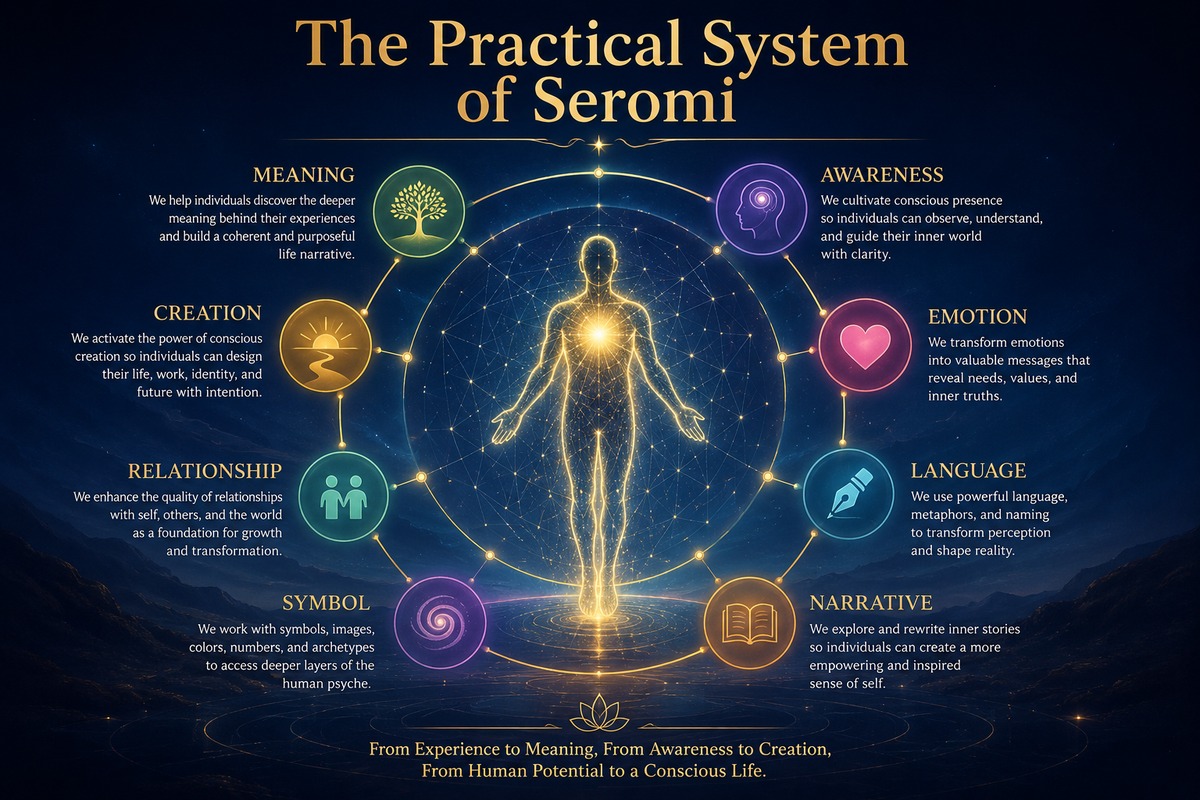
Seromi System: An Architecture of Meaning, Awareness, and Creation in Human Transformation
Author: Soheila Dadkhah
Abstract
The Seromi System is an interdisciplinary framework in the field of human transformation, grounded in meaning-making, self-awareness, emotional interpretation, narrative reconstruction, symbolic understanding, linguistic patterns, neuro-linguistic programming, personal guidance, and transformational psychology. It offers a coherent process through which individuals can understand themselves more deeply, reinterpret their lived experiences, and consciously create the direction of their lives. The system is based on the view that human beings continuously experience, interpret, choose, and construct their inner and outer worlds.
Within the Seromi approach, human experiences are understood as meaningful data rather than isolated life events. Emotions, relationships, failures, fears, attachments, inner silence, identity crises, and even periods of meaninglessness may serve as gateways to self-understanding. Through this system, individuals learn to observe their experiences, recognize recurring patterns, understand the hidden messages of emotions, and form new choices based on expanded awareness.
The central aim of Seromi is not temporary relief or superficial motivation. Its deeper purpose is to cultivate the human capacity for conscious creation. In this framework, the individual is not merely a receiver of knowledge or advice, but an active researcher of personal experience, a reader of inner narratives, and a creator of future possibilities. Seromi helps individuals reread themselves, understand the symbolic and emotional language of their experiences, and establish a more conscious relationship with themselves, others, work, purpose, crisis, and the future.
Introduction
Human transformation is one of the central concerns of psychology, philosophy of life, education, personal development, and meaning-centered studies. Contemporary individuals face a wide range of challenges, including emotional confusion, relational pressure, identity crises, occupational fatigue, existential uncertainty, and repetitive behavioral patterns. Many people intellectually understand what may be beneficial for them, yet in decisive moments they often return to old reactions, familiar fears, and repeated choices. This distance between knowing and living is one of the fundamental challenges in the field of human growth.
A considerable part of human struggle appears at the level of behavior, but its roots often lie in deeper layers. Hidden beliefs, emotional memories, inner narratives, self-image, internal language, bodily experience, and the way individuals assign meaning to events all influence decision-making and behavior. Sustainable transformation therefore requires more than behavioral correction or intellectual insight. It requires access to the emotional, symbolic, narrative, and meaning-based layers of human experience.
The Seromi System begins precisely at this point. It approaches human experience as a living text that can be read, interpreted, and transformed. Life, in this view, resembles a dynamic book in which each chapter contains signs, repetitions, ruptures, desires, wounds, and emerging possibilities. Some chapters are written through pain, some through love, some through fear, some through silence, and others through hope. Seromi enables individuals to read this book with accuracy, compassion, and awareness.
The significance of Seromi lies in its ability to connect lived experience with conscious creation. Instead of remaining trapped in automatic reactions, inherited narratives, or emotionally driven decisions, the individual learns to pause, recognize the current inner state, understand the meaning of the experience, and then act from a more conscious position. This movement from reaction to awareness, and from awareness to creation, forms the central logic of transformation within the Seromi System.
Conceptual Definition of the Seromi System
The Seromi System may be defined as a conceptual and practical framework for transforming human experience into awareness and transforming awareness into conscious life creation. This definition includes three essential dimensions: experience, awareness, and creation. Experience is the raw material of transformation; awareness is the process through which experience is observed and understood; creation is the practical and lived expression of this awareness in personal and social life.
From the perspective of Seromi, every human experience contains multiple layers. An external event may appear simple on the surface, yet internally it can activate a chain of emotions, memories, beliefs, mental images, and personal meanings. For example, a relational conflict may awaken feelings of rejection, anger, fear of abandonment, a need to be seen, or an old emotional memory. Seromi regards these inner activations as important signs for self-understanding.
In this framework, the human being is understood as a meaning-making being. Each person interprets the world through personal narratives, values, past experiences, and inner images of the self. Therefore, lasting change occurs when these interpretive lenses are recognized and reconstructed. Seromi allows individuals to understand why a specific situation feels threatening, repetitive, painful, attractive, or emotionally intense, and how that situation can become a source of awareness.
The Seromi understanding of transformation is closely connected to the concept of creation. Creation here refers to the conscious construction of one’s way of living: daily choices, professional direction, relational quality, bodily awareness, inner language, future image, and personal identity. Within Seromi, life is not merely something to be endured or managed; it is a field of conscious creation. This view turns Seromi into a living architecture of human transformation.
The Position of Seromi in Human Transformation Studies
Human transformation studies have historically drawn from diverse fields such as humanistic psychology, meaning-centered therapy, narrative approaches, learning theory, neuro-linguistic programming, existential philosophy, symbolic psychology, and contemporary models of personal growth. Seromi can be situated within this broader intellectual and practical tradition. Its value lies not in the mechanical combination of concepts, but in the creation of an integrated language through which human experience can move from fragmentation toward understanding, coherence, and creative action.
In many personal development approaches, the primary focus is placed on behavioral change, performance improvement, or habit formation. These goals are valuable, yet behavior is often the final expression of a deeper chain. Before behavior, there is emotion; before emotion, there is meaning; before meaning, there are formative experiences; and within all these layers, the person’s self-narrative is constantly operating. For this reason, Seromi begins with the language of experience and extends transformation toward behavior, choice, and external creation.
The academic position of Seromi can be explained through the interaction of three domains: the cognitive domain, the emotional domain, and the narrative domain. In the cognitive domain, individuals examine beliefs, mental patterns, and interpretive frameworks. In the emotional domain, feelings are read as meaningful inner messages. In the narrative domain, the individual revisits the story constructed about the self, the past, and the future. Together, these domains create the possibility of reconstructing identity and designing a new life direction.
Practically, Seromi may be applied to personal development, relational improvement, career decision-making, crisis navigation, identity reconstruction, life-path design, communication skills, and the expansion of self-awareness. This broad applicability results from the human-centered and meaning-centered nature of the system. Wherever human beings encounter experience, emotion, choice, and meaning, Seromi can provide a useful analytical and practical framework.
Theoretical Foundations of the Seromi System
The theoretical foundations of Seromi rest on the assumption that the human being is multidimensional and that transformation must therefore be understood multidimensionally. Human beings do not change through logic alone. They also do not achieve lasting transformation through emotion, motivation, or behavioral repetition alone. Deep transformation occurs when mind, feeling, body, language, image, memory, narrative, and action become connected within a coherent process.
The first foundation of Seromi is meaning-making. Human beings do not merely experience events as they happen; they experience them through the meanings they assign to them. A failure may be interpreted by one person as evidence of personal inadequacy, while another may experience it as an invitation to revise a life path. A relationship may become a field of dependency for one individual and a field of growth for another. Meaning shapes emotion, decision-making, and the imagination of the future.
The second foundation is self-awareness. In Seromi, self-awareness refers to the living observation of the self in the present moment. The individual learns to notice what emotion has become active, what thought is repeating itself, what image of the past or future is guiding behavior, and what message the body is communicating. This observation is not judgmental; it is careful, compassionate, and investigative.
The third foundation is creation. Seromi does not limit transformation to understanding the past. It links awareness to the construction of the future. Awareness becomes complete when it appears in choice, relationship, decision, action, and style of living. In this sense, the individual within Seromi is not only an interpreter of life but also a creator of life.
Meaning-Making in Human Experience
Meaning occupies a central position in the Seromi System. Meaning is the force that transforms raw and scattered experience into living knowledge about the self. Human beings may encounter similar events, yet their responses differ because each person interprets experience through personal history, values, wounds, hopes, and inner narratives. Meaning determines whether an event becomes an obstacle, an opportunity, a threat, or an invitation to growth.
For example, the end of a relationship may be interpreted as absolute failure, personal unworthiness, or fear of the future. The same experience, when consciously reinterpreted, may become an opportunity to understand patterns of attachment, revise emotional boundaries, recognize neglected needs, and rebuild the individual’s relationship with the self. Seromi enters precisely at this point: where the person moves beyond the surface event and listens to the hidden language of experience.
Meaning-making within Seromi is shaped by fundamental questions. What does this experience reveal about me? Which emotion has become active in this situation? To which belief or memory is this reaction connected? What need is hidden behind this state? These questions shift the individual from reactivity to observation and understanding. As a result, experience becomes a source of awareness rather than merely a source of distress.
The importance of meaning-making lies in the fact that human beings relate to pain, love, failure, purpose, relationships, and the future through meaning. Without meaning, experiences may feel fragmented and exhausting. With meaning, those same experiences can become steps toward inner maturity. Seromi teaches the art of reading these meanings, bringing individuals closer to deeper self-understanding and more conscious life creation.
Self-Awareness and Inner Observation
Self-awareness in Seromi is a dynamic and experiential concept. It does not merely refer to knowing a few personality traits or identifying strengths and weaknesses. Self-awareness means the ability to observe oneself in the moment. The individual notices what feeling is moving through the body, what thought is occupying the mind, what image of the self has become active, and what need may be hidden behind a behavior.
Many human reactions occur quickly and habitually. In response to criticism, a person may become defensive. In response to intimacy, another may withdraw. In response to opportunity, someone may become afraid. In response to conflict, another may remain silent. Seromi studies these reactions as signs for inner observation. The aim is for the individual to recognize the moment of activation before becoming fully absorbed by the reaction. This recognition is the beginning of inner freedom.
Inner observation in Seromi is calm, precise, and non-condemning. The individual is not asked to blame the self or search for guilt. Instead, the person becomes a compassionate researcher of the inner field. What moved within me? Which image frightened me? Which memory became alive in this moment? What is my body communicating? Through these questions, a conscious distance gradually appears between external stimulus and internal reaction.
This conscious distance is one of the most important achievements of the Seromi approach. Within this distance, the possibility of choice emerges. The individual may repeat the old pattern or create a new response. One may speak from fear or from awareness, from an old wound or from maturity. Therefore, self-awareness in Seromi is not a purely theoretical skill; it is a practical force that changes the quality of living.
Emotion as the Language of Needs
Emotions hold a fundamental place in Seromi because they are among the most direct pathways to human needs, values, wounds, and hidden truths. Every emotion carries a message. Anger may indicate a violated boundary. Sadness may point to grief, loss, or a need for acceptance. Fear may reveal the individual’s relationship with security, the future, or personal capability. Jealousy may point toward a suppressed desire or painful comparison. Love may reveal the quality of connection, presence, and openness.
In many contexts, emotions are divided into positive and negative categories. Seromi approaches emotions as an inner language rather than as enemies to be eliminated or simple states to be labeled. The central question is: What is this emotion communicating? What does it want to reveal? When individuals enter a conscious relationship with their emotions, they gain access to deeper aspects of themselves instead of suppressing, justifying, or escaping what they feel.
The interpretation of emotion in Seromi also includes attention to the body. Many emotions appear in the body before they are expressed in language. Tightness in the chest, contraction in the throat, pressure in the stomach, trembling hands, sudden fatigue, or numbness may all indicate inner activation. The body functions as a living record of experience. Seromi invites individuals to listen to this bodily language and examine it alongside thought and narrative.
When emotions are understood, their energy can be transformed from chaos into awareness. The individual is no longer merely carried away by emotional waves but learns to read their message. This altered relationship with emotion is one of the essential foundations of transformation in Seromi. A person who understands emotions becomes closer to personal needs, clearer about boundaries, and more capable of making healthy choices.
Narrative and the Reinterpretation of Life
Human beings do not live only through events; they live through the stories they construct about those events. A childhood experience of rejection may become the story “I am not lovable.” A professional failure may turn into the narrative “I am not capable.” A painful relationship may become the belief “Trust is dangerous.” Over time, these narratives become lenses through which the individual sees the self, others, and the future.
Seromi gives special attention to inner narratives because they guide behavior and choice. A person who sees the self as a permanent victim may interpret the world from a position of powerlessness. A person who feels chronically unseen may search for signs of neglect in every relationship. A person who views the future as threatening may contract even in the presence of growth opportunities. Therefore, transforming narrative can make transformation of life possible.
Narrative reinterpretation in Seromi does not mean denying the past or creating artificial optimism. It means reading one’s story with greater depth, accuracy, and awareness. The individual learns to distinguish which parts of the narrative arise from wounds, which parts from fear, which parts from lived reality, and which parts from old interpretations. When a narrative becomes less rigid, the possibility of rewriting it appears.
Through this process, individuals learn to see their lives from a new angle. An experience previously interpreted as weakness may now be understood as sensitivity, effort, survival, or a need for care. The past may no longer function only as a source of pain; it may also become a reservoir of insight. Seromi acts as a light cast upon the text of life, illuminating sections that previously remained in shadow.
Symbol and Image in the Process of Transformation
Symbols and images play an important role in Seromi because the deeper layers of human experience are not always expressed through direct and logical language. Many profound experiences appear through images, colors, metaphors, dreams, bodily sensations, stories, and signs. A person may describe an inner state by saying, “I feel as if I am in a closed room,” “It feels like I am carrying a heavy weight on my shoulders,” or “Inside me there is a stormy sea.” These metaphors are not merely decorative language; they are gateways into the structure of inner experience.
Seromi uses symbol and image to understand the inner state more accurately. When individuals describe their emotional state through an image, deeper observation becomes possible. For example, if fear is experienced as a high wall, one may ask: What is this wall made of? What is behind it? When did it appear? How can the person relate to it? This approach brings the language of analysis closer to the living language of experience.
Symbols also connect personal experience with broader human patterns. Across history, human beings have expressed inner transformation through images such as journey, passage, darkness, rebirth, hero, shadow, home, mirror, and fire. Seromi can use this symbolic field to understand the path of transformation. When a person experiences crisis as a stage of passage, the relationship with crisis changes and the possibility of growth becomes more visible.
The importance of symbol in Seromi lies in the fact that human beings sometimes understand something before they can fully explain it. Image provides access to this pre-verbal understanding. By working with symbol and narrative, Seromi expands transformation beyond rational speech and into the fuller field of human experience, where mind, emotion, body, and imagination function together.
Conscious Creation of the Life Path
Creation in Seromi is the point at which awareness enters life. After observing experience, understanding emotion, and reinterpreting narrative, the individual reaches the question: What do I want to create now? This creation may be internal or external. It may involve changing a conversation, establishing a boundary, beginning a new path, accepting a truth, revising a relationship, or reshaping the image of the self.
Conscious creation differs from reaction. Reaction is usually fast, habitual, and shaped by previous patterns. Creation involves pause, presence, understanding, and choice. In conscious creation, the individual asks: Based on which value do I want to act now? Which response is more aligned with my inner truth? What quality is this experience inviting me to build in my life? Such questions elevate action from habit to meaning.
In Seromi, creation is not limited to external achievement. Building a healthy relationship, restoring honesty to inner language, caring for the body, setting boundaries, accepting an emotion, ending an unhealthy cycle, or beginning a meaningful educational path can all be forms of creation. Creation means designing a more aware and authentic way of living rather than continuing to live according to outdated inner scripts.
This perspective also emphasizes human responsibility. Responsibility in Seromi does not mean blaming the individual for the past. It means reclaiming the capacity to choose in the present. As awareness expands, the field of creation also expands. The individual comes to understand that even within limitations, the quality of response can be chosen, and from this response a new future may be built.
The Three-Stage Model of Seromi
The practical model of Seromi is based on three central stages: presence, emotion, and creation. These stages describe the movement from observing the current state, to understanding the message of experience, and then to forming conscious action. Presence is the beginning because the individual must first know where they are. Emotion is the stage of reading inner messages because experience remains incomplete without emotional understanding. Creation is the stage in which awareness becomes action and a new direction.
This model may appear simple, yet it is deeply transformative in practice. Many individuals move directly from experience to reaction. An event occurs, emotion becomes active, and the person immediately acts according to an old pattern. Seromi creates three conscious stations between event and reaction. First, the person becomes present. Then the emotion is read. Finally, a choice is created that is more aligned with the new awareness.
The importance of this model lies in its everyday applicability. It can be used in relationships, work, decision-making, conflict, fear, anger, failure, or goal setting. For example, in a difficult conversation, the stage of presence may help a person recognize bodily contraction and defensive thinking. The stage of emotion may reveal that behind this defense lies a fear of being unseen. The stage of creation may allow the person to express a clear and respectful boundary instead of attacking or withdrawing.
For this reason, the three-stage model of Seromi serves as a bridge between theory and daily life. It reminds individuals that transformation does not always begin with dramatic external change. Sometimes it begins with a brief pause, an honest observation, an understood emotion, and one new choice. Over time, these small moments can reshape the architecture of life.
Presence
Presence in Seromi refers to the conscious return to the present moment. At this stage, the individual asks: Where am I now? What has become active within me? What is my body experiencing? What story is my mind constructing? From which emotion, belief, or need am I moving? These questions draw the individual out of full absorption in the external event and invite observation of the inner state.
Presence is a trainable quality. Many people spend much of their lives mentally located in the past or the future. The mind is either replaying past events or predicting future dangers. In such a state, reactions often arise from memory or anxiety. Through the stage of presence, Seromi helps the individual return to the present and recognize the actual inner condition. This recognition is the foundation of conscious choice.
The body plays an important role in presence. The body often communicates before the mind can articulate what is happening. Contraction, warmth, coldness, heartbeat, tightness, numbness, or sudden fatigue may all be signs of inner activation. When individuals listen to the body, they gain valuable information about their emotional state. Seromi treats this information as part of awareness and examines it alongside thought and narrative.
Presence creates distance between the individual and the reaction. This distance does not mean disconnection from experience. It means seeing the experience with greater clarity. A present individual is not swallowed by the wave; they see the wave, feel its movement, and can then choose how to respond. In Seromi, presence is the first gateway to transformation.
Emotion
The stage of emotion in Seromi is dedicated to reading the inner message of experience. After becoming present and observing the current state, the individual asks: What is this emotion communicating? What wants to be seen? What need stands behind it? To which memory, value, fear, or desire does this emotion connect me? These questions transform emotion from chaos into knowledge.
In daily life, emotions are often labeled too quickly. A person may say, “I am angry,” “I am sad,” “I am afraid,” or “I feel empty.” Seromi invites the individual to look beneath these labels. What exactly is the anger about? What is the sadness mourning? What future does the fear imagine? What need is hidden inside the emptiness? When emotions are explored with this degree of precision, they reveal deep information about the self.
The emotional stage also creates a kinder relationship with the self. Many individuals suppress, justify, hide, or fight their feelings. In Seromi, emotions are treated as visitors carrying messages. Each visitor must be seen and heard so that its energy can become awareness. This approach moves the person away from inner conflict and toward a deeper dialogue with the self.
When emotion is understood, decision-making becomes healthier. A person who understands anger can set boundaries. A person who recognizes fear can distinguish real danger from mental projection. A person who accepts grief can begin the process of repair. Therefore, emotion is the heart of the transformational process in Seromi: the place where experience becomes message, and message becomes awareness.
Creation
Creation is the third stage of the Seromi model and refers to the transformation of awareness into choice and action. After presence and emotional understanding, the person arrives at the question: What do I want to create now? This creation can take many forms. It may involve a new way of speaking, a new relational boundary, a new professional decision, a revised self-image, or a more truthful way of living.
Creation in Seromi is connected to values. A person creates consciously when they know what matters. Security, honesty, growth, love, freedom, respect, peace, creativity, and meaning may all guide choice. When individuals recognize their values, their decisions become less scattered and more coherent. This coherence is one of the signs of inner maturity.
The stage of creation connects Seromi to practical life. Awareness becomes meaningful when it appears in language, behavior, relationship, and decision. After understanding a pattern of dependency, a person may choose to establish healthier boundaries. After recognizing fear of failure, one may begin a project that has been postponed for years. After understanding hidden anger, one may initiate an honest conversation. These are all examples of conscious creation.
Ultimately, creation gives the individual a sense of agency. Agency means experiencing oneself as an active participant in shaping life. This sense is central to psychological health and human development. By guiding individuals from experience to awareness and from awareness to creation, Seromi supports the return of agency. The individual learns that even within limitation, the quality of response can be chosen, and through that response a new path can begin.
Applications of the Seromi System
The Seromi System can be applied across diverse areas of life because of its meaning-centered and human-centered nature. Its first area of application is personal development. Individuals can use Seromi to identify repetitive patterns, transform their relationship with emotions, reinterpret inner narratives, and create a new way of living. This is especially valuable for those experiencing confusion, hesitation, emotional dependency, fear of decision-making, fatigue, or a sense of meaninglessness.
The second application is in human relationships. Relationships often activate wounds, needs, expectations, and old narratives. In romantic, family, or professional relationships, a person may repeatedly experience misunderstanding, defensiveness, silence, anger, or fear. Seromi helps each relational reaction become data for understanding the self and the quality of the relationship. As a result, individuals can develop clearer boundaries, healthier language, and more conscious presence in relationships.
The third application is in professional and career development. Many career decisions are made only on the basis of income, security, or social pressure, while meaning, values, identity, and a sense of contribution also play a significant role in professional fulfillment. Seromi helps individuals examine their relationship with work, purpose, talent, fear of failure, desire for recognition, and need for creativity. Through this process, professional choices may become more conscious and more aligned with personal identity.
The fourth application is in education, art, and life crises. In education, Seromi can connect learning with meaning and self-knowledge. In art, it can support the transformation of inner experience into creative expression. In crisis, it can help individuals view difficult events as opportunities for reinterpretation, reconstruction, and the emergence of new meaning. In this way, Seromi can provide a new language for transformation at both personal and social levels.
The Distinctive Orientation of Seromi in Personal Growth
The distinctive quality of Seromi lies in its integrative view of the human being. Many approaches focus primarily on one dimension: behavior, thought, emotion, motivation, meaning, or performance. Seromi examines these dimensions together and establishes a living relationship among them. In this system, behavior is understood through meaning, emotion is read through narrative, and awareness reaches completion through creation. This multilayered integration makes Seromi a comprehensive framework for human transformation.
Another important feature of Seromi is its attention to lived experience. It does not rely on identical formulas for all individuals. Every person has a unique history, language, body, image, memory, and narrative. Therefore, the transformational path must be shaped in relation to that person’s inner world. This orientation gives the growth process depth and authenticity, guiding individuals from imitation of external models toward discovery of their own path.
Seromi also gives importance to the quality of the process rather than focusing only on outcomes. Outcomes matter, but an outcome that does not arise from awareness may remain internally empty despite external success. In Seromi, the key question is not merely what the individual achieves, but from which level of awareness, with which meaning, and based on which value the individual moves. This orientation transforms growth from an external race into a path of inner maturity.
From a linguistic perspective, Seromi offers a precise and human-centered vocabulary for transformation. Words such as presence, meaning, emotion, narrative, symbol, creation, path, and awareness are not merely theoretical terms. They are tools for seeing life. When individuals find a new language for their experiences, they also discover a new possibility for living. In Seromi, language is not merely a means of expression; it is part of the construction of inner reality.
Conclusion
The Seromi System can be understood as a comprehensive framework for interpreting and guiding human transformation. It examines life experiences as living sources of awareness, meaning, and creation. In this system, the human being is meaning-oriented, emotional, narrative, aware, and creative. Through Seromi, individuals can read their experiences, recognize repetitive patterns, and create a new life path from the insight they gain.
The significance of Seromi lies in the connection it establishes among meaning, emotion, narrative, symbol, language, and action. It shows that human transformation does not occur in the mind alone, nor is it reducible to behavior. Transformation becomes deeper when individuals observe themselves in the present moment, understand the messages of their emotions, reinterpret their life narratives, and turn awareness into choices, relationships, work, identity, and future direction.
The three-stage model of presence, emotion, and creation clarifies the practical path of this transformation. The individual first recognizes the current inner state, then reads the message of experience, and finally creates a new response from awareness. This process may be applied to personal growth, relationships, work, education, art, and life crises.
Ultimately, Seromi may be described as a meaningful world for rereading the human being. In this world, pain can become message, fear can become awareness, relationship can become mirror, failure can become revision, and life can become a field of creation. Through Seromi, individuals learn to read themselves again, find meaning in their experiences, and create a more authentic version of life from the depth of awareness.
Frequently Asked Questions
1. What is the Seromi System?
The Seromi System is an interdisciplinary framework for human transformation based on meaning, awareness, emotion, narrative, symbol, language, neuro-linguistic programming, personal guidance, and transformational psychology. It helps individuals understand their experiences, read the messages of their emotions, recognize repetitive patterns, and consciously create their life path.
2. What is the main purpose of Seromi?
The main purpose of Seromi is to transform human experience into awareness and awareness into conscious creation. Through this process, individuals learn to move from habitual reactions toward presence, emotional understanding, and intentional choice.
3. How does Seromi work with emotions?
In Seromi, emotions are understood as carriers of inner messages. Each emotion may point to a need, value, wound, memory, or hidden truth. By understanding emotions rather than suppressing them, individuals can make healthier choices and build a deeper relationship with themselves.
4. Why is narrative important in Seromi?
Narrative is important because human beings live through the stories they construct about themselves, their past, and their future. Seromi helps individuals reinterpret limiting narratives and create more conscious, mature, and constructive life stories.
5. Where can the Seromi System be applied?
Seromi can be applied in personal development, relationships, career decision-making, education, art, crisis navigation, identity reconstruction, and life-path design. Wherever human beings encounter experience, emotion, meaning, and choice, Seromi can serve as a framework for deeper understanding and conscious creation.
Suggested References
Frankl, V. E. (2006). Man’s Search for Meaning. Beacon Press.
Frankl, V. E. (1988). The Will to Meaning: Foundations and Applications of Logotherapy. Meridian.
Bruner, J. (1990). Acts of Meaning. Harvard University Press.
Bruner, J. (1986). Actual Minds, Possible Worlds. Harvard University Press.
Rogers, C. R. (1961). On Becoming a Person: A Therapist’s View of Psychotherapy. Houghton Mifflin.
Rogers, C. R. (1980). A Way of Being. Houghton Mifflin.
Jung, C. G. (1964). Man and His Symbols. Dell Publishing.
Jung, C. G. (1969). The Archetypes and the Collective Unconscious. Princeton University Press.
White, M., & Epston, D. (1990). Narrative Means to Therapeutic Ends. Norton.
White, M. (2007). Maps of Narrative Practice. Norton.
Prochaska, J. O., Norcross, J. C., & DiClemente, C. C. (1994). Changing for Good. William Morrow.
Maslow, A. H. (1968). Toward a Psychology of Being. Van Nostrand.
May, R. (1983). The Discovery of Being: Writings in Existential Psychology. Norton.
Yalom, I. D. (1980). Existential Psychotherapy. Basic Books.
Gendlin, E. T. (1981). Focusing. Bantam Books.
Lakoff, G., & Johnson, M. (1980). Metaphors We Live By. University of Chicago Press.
McAdams, D. P. (1993). The Stories We Live By: Personal Myths and the Making of the Self. Guilford Press.
Mezirow, J. (1991). Transformative Dimensions of Adult Learning. Jossey-Bass.
Bandura, A. (1997). Self-Efficacy: The Exercise of Control. W. H. Freeman.
Seligman, M. E. P. (2011). Flourish: A Visionary New Understanding of Happiness and Well-being. Free Press.
Part Three: Reconstructing Distorted Needs Using NLP Plus Techniques Author:
Part One: Defining Natural Human Needs Author: Soheila Dadkhah Abstract