
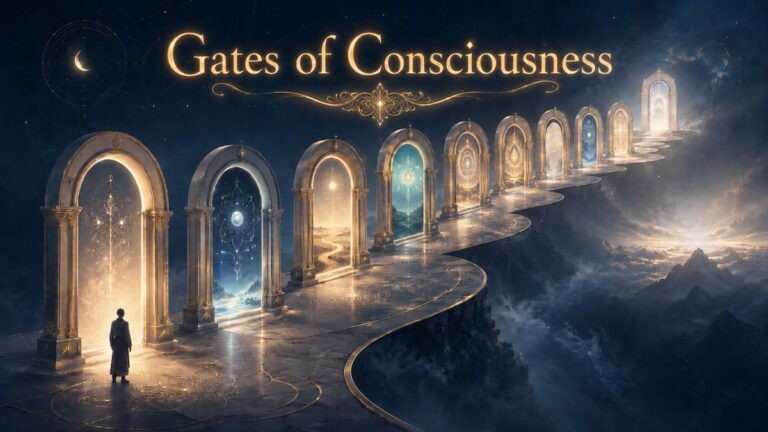
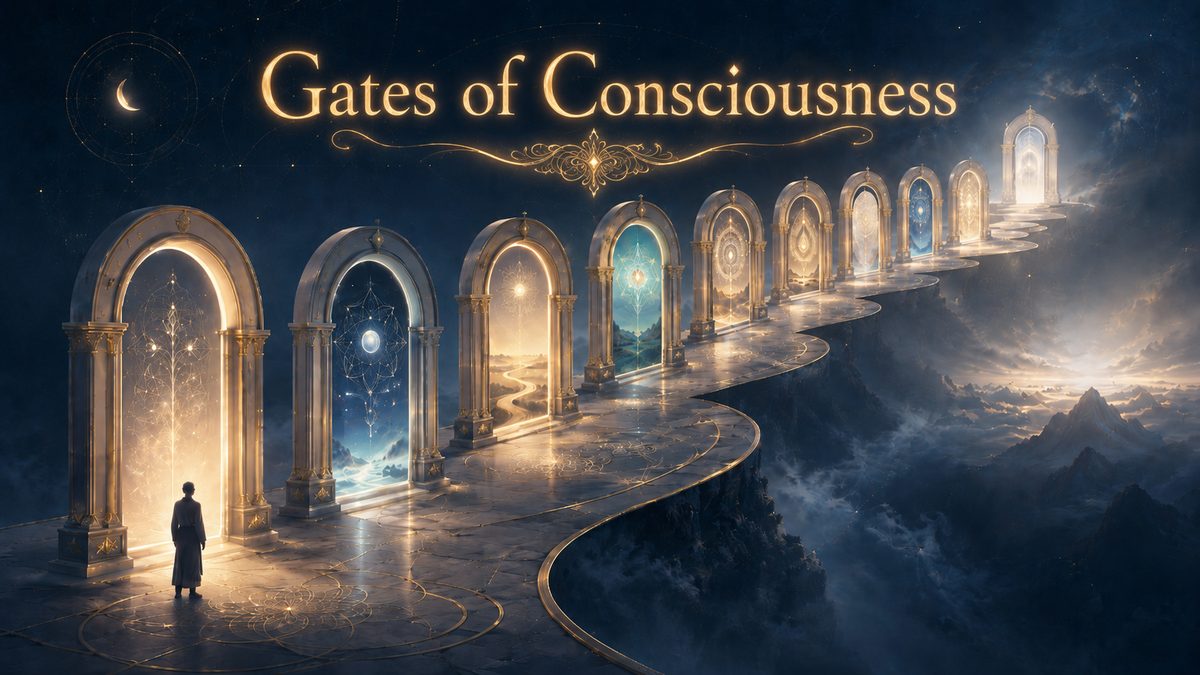
The Gates of Consciousness
The Gates of Consciousness.An Analysis of the Nine Gates of Awareness
A Psychological and Social Analysis of the Nine Gates of
Gate Five. I See
Author: Soheila Dadkhah
Abstract
The gate of “I See” is the fifth stage in the architecture of the gates of awareness within the Seromi System. This gate explores the human capacity to observe the self, inner patterns, repeated behaviors, relationships, choices, fears, wounds, and unconscious structures of life. At this stage, the human being begins to create distance from complete identification with emotion, reaction, or inner narrative, and for the first time can observe part of the self from a more conscious position.
“Seeing” in this gate does not mean judging, overanalyzing, blaming, or searching for fault. Seeing means the ability to remain present before truth without collapse and without escape. At this stage, the human being realizes that many forms of suffering do not arise only from external events, but also from unseen patterns that have repeated themselves again and again throughout life.
The fifth gate comes after stability and endurance, because deep seeing requires an inner container. A person who is still displaced by every emotional wave is usually unable to observe their patterns without defense or shame. But when a degree of stability has been formed, the eye of awareness becomes more active. This article examines the cognitive, emotional, bodily, linguistic, and existential dimensions of the gate of “I See” and shows how conscious observation can become the beginning of real transformation.
Keywords
Gate of I See, gates of awareness, Seromi System, conscious observation, inner witness, self-awareness, metacognition, repeated patterns, seeing without judgment, NLP, emotional regulation, bodily awareness, pattern recognition, human transformation, presence, acceptance of truth
Introduction
After a human being is able to say “I Am,” experience their emotions, activate the power of creation, and then find a relative degree of stability on their path, a new stage begins:
What do I now see in myself and in my life?
Seeing here does not mean looking with the physical eyes. A person may live for years, make decisions, build relationships, suffer, repeat, fail, succeed, and walk the same paths again, yet still not truly see. They may see events, but not patterns. They may see reactions, but not roots. They may see the behavior of others, but not their own participation. They may see suffering, but not the repeating structure behind that suffering.
In the Seromi System, the fifth gate is the moment when the human being steps slightly back from inside the cycle and says:
I am not only this experience; I can also see this experience.
This small distance is the beginning of freedom. As long as a person is completely identified with their pattern, they experience it as absolute truth. But when they are able to see it, their entire being is no longer the pattern. Instead of saying, “I am a failure,” they can say, “There is a pattern in me that turns failure into identity.” Instead of saying, “Everyone leaves me,” they can see how the fear of abandonment shapes their behavior. Instead of saying, “This is just who I am,” they can ask: Where did this repetition begin?
The fifth gate is the gate of the inner witness. This witness is not cold, judgmental, or avoidant. It sees. And this seeing is the first opening in unconsciousness.
Guiding Questions of the Article
This article is shaped around several central questions:
What does seeing mean on the path of awareness?
What is the difference between seeing, thinking, analyzing, and judging?
Why does a person usually repeat their patterns until they are able to see them?
What is the relationship between inner stability and the capacity to observe?
How do shame, fear, psychological defense, or denial prevent the seeing of truth?
What role do the body, emotion, and language play in conscious observation?
What is the difference between seeing one’s part in an experience and blaming oneself?
How can a human being see their pattern without collapsing into it?
How does the gate of “I See” prepare the ground for deeper understanding?
What “I See” Does Not Mean
To understand this gate accurately, it is necessary to clarify what “I See” does not mean.
This gate does not mean judging the self. Many people believe that when they see a truth about themselves, they must immediately condemn themselves. But conscious seeing is different from condemnation. Condemnation contracts the human being; seeing opens the possibility of transformation.
This gate does not mean endless analysis. Sometimes a person becomes trapped in the mind in the name of self-knowledge. They keep thinking, searching for causes, examining the past, but nothing changes in their life. This is not seeing; it is mental circulation.
“I See” also does not mean finding someone to blame. In this gate, the human being is not trying to prove who was bad, who made the mistake, or who should be blamed. They are seeking to understand the structure that produced suffering, reaction, or repetition.
This gate does not mean becoming emotionless. The inner witness is not a cold separation from life. A person can feel and see at the same time. They can cry and also notice what has become active within them. They can feel fear and also see which pattern this fear has awakened.
The meaning of this gate is:
I can observe what repeats in me and in my life with presence, courage, and kindness.
Seeing, Thinking, and Judging
The fifth gate distinguishes between three levels: thinking, judging, and seeing.
Thinking
Thinking is an activity of the mind. The mind places information together, finds causes, creates conclusions, and produces narratives. Thinking can be useful, but it is not necessarily seeing. Sometimes a person thinks a great deal but sees very little.
Judging
Judging is usually accompanied by labels. The mind says: I am bad. They are guilty. This situation is a failure. This feeling is weakness. This mistake is unforgivable. Judgment often closes the field and reduces the possibility of deep observation.
Seeing
Seeing means observing what is, as much as possible without distortion, without rushing to change it, and without escaping from truth. Seeing means that the human being can say:
This pattern exists in me.
This reaction has repeated many times.
This fear becomes active in similar situations.
This relationship awakens an old wound.
I have a part in this experience, but the entire burden of life is not on me.
Seeing is the starting point of maturity, because a person can consciously change only what they have first seen.
Seeing Patterns
One of the most important functions of the fifth gate is recognizing patterns. A pattern is a repetition that appears in different forms but has a similar root.
For example:
A person fears rejection in different relationships.
Someone withdraws before being seen in different areas of work.
A person repeatedly sabotages the path when they come close to success.
Someone either attacks or becomes completely silent in conflict.
A person repeatedly takes the role of rescuer and then feels like a victim.
Someone feels suffocated whenever love becomes close.
On the surface, these may seem like separate events. But in the fifth gate, the human being begins to see that behind these apparently different experiences, there may be one repeating pattern.
Seeing the pattern helps the person move away from blind repetition. As long as the pattern is unseen, the person may call it fate, personality, bad luck, or the absolute truth of life. But once it is seen, it becomes an object of awareness.
Seeing Without Collapse
One of the difficulties of this gate is that when a person sees a truth about themselves, they may fall into shame, fear, or collapse. They may say:
So everything was my fault.
So I am broken.
So I have always been wrong.
So there is no hope.
But this is not conscious seeing; this is activated shame.
The fifth gate reminds us:
Seeing one’s part does not mean blaming oneself completely.
Seeing a pattern does not mean condemning one’s identity.
Seeing a wound does not mean the human being is worthless.
Seeing darkness means that the possibility of more light has become available.
This is why this gate comes after stability. A human being needs a container in order to see truth. Without a container, truth may become shame instead of freedom.
The Cognitive Dimension of the Gate of “I See”
In the cognitive dimension, the human being activates metacognition; that is, the ability to see thought instead of being completely identified with thought.
They ask:
What story is my mind creating right now?
Is this thought an absolute truth or an old narrative?
From which past experience is this reaction being fed?
What pattern has repeated itself in my life?
Am I seeing the present situation through the wound of the past?
Which belief causes me to interpret this event in this way?
Am I seeing what is here, or am I predicting what I fear?
At this stage, the person steps out of the narrative and observes the narrative itself. This is very important, because the human mind does not merely report reality; sometimes it constructs reality through the filters of fear, belief, past experience, and future expectation.
Cognitive seeing means recognizing these filters.
The Emotional Dimension of the Gate of “I See”
Seeing is never only cognitive. Every pattern carries an emotion within it. Sometimes a person does not see something because seeing it would awaken a difficult feeling.
For example:
Seeing dependency may bring shame.
Seeing hidden anger may create fear.
Seeing the need for love may activate vulnerability.
Seeing one’s part in a relationship may bring grief.
Seeing an inner lie may create the feeling of falling apart.
In this gate, emotions are not obstacles to seeing; they are part of seeing. The human being learns to observe their emotions while observing the truth.
They say:
I see this pattern.
And at the same time, I see that seeing it activates shame, fear, or grief in me.
This ability is a sign of emotional maturity.
The Bodily Dimension of Seeing
The body often understands before the mind that a truth is coming close. When an important pattern is being seen, the body may react:
The throat may tighten.
The chest may feel heavy.
The breath may become short.
The stomach may contract.
The hands may become cold or warm.
The body may become restless.
Tears may come.
Or a deep silence may suddenly appear.
These signs are not random. The body is a doorway to truth. Sometimes the mind is still resisting, but the body shows that something has been seen.
The fifth gate invites the human being not to pay attention only to thoughts while observing a pattern. The body must also be heard. The body may reveal which truth has not yet been digested, which memory is still active, and which fear still needs safety.
Language as a Tool of Seeing
Human language can either make seeing possible or close it down. Sentences that are based on labels, absolutes, or blame usually limit the field of observation.
For example:
I always ruin everything.
No one loves me.
I will never change.
Everyone is against me.
I am the absolute victim.
Everything is my fault.
These sentences stop seeing because they turn experience into a final verdict.
Conscious language is more observational:
There is a pattern in which I damage the relationship.
A part of me believes that I am not lovable.
Change has been difficult for me, but it is not impossible.
In this situation, I feel threatened.
I have a part in this experience, and I can see it.
This kind of language creates space. It separates the human being from a fixed identity and brings them closer to observation.
The fifth gate teaches the human being to transform language from judgment into observation.
Seeing One’s Part Without Self-Blame
One of the most delicate parts of this gate is seeing one’s own participation. Many people become trapped between two extremes:
They either place everything on others.
Or they place everything on themselves.
Neither is conscious seeing.
Seeing one’s part means asking:
What role have I played in this cycle?
Which reaction of mine strengthened this pattern?
Which fear caused me to make an unconscious choice?
Where did I remain silent when expression was needed?
Where did I attack when I needed a boundary?
Where did I abandon myself so that someone else would not abandon me?
These questions are not for blame. They are for reclaiming power. As long as a person does not see their own part, they can only wait for the outer world to change. But when they see their part, they find a point where a new choice becomes possible.
Seeing the Other Without Projection
The fifth gate is not only about seeing the self; it is also about seeing the other. But seeing the other becomes conscious only when the human being can recognize their own projections to some degree.
Sometimes a person sees the other through their wound, not through the reality of the other.
Someone who has often been rejected may interpret every silence as rejection.
Someone who has experienced betrayal may interpret every distance as betrayal.
Someone who has been controlled may experience every simple request as control.
Someone who has not been seen may interpret every lack of attention as proof of their own worthlessness.
The fifth gate does not say that human perception is always wrong. It says:
Before I treat my interpretation as absolute truth, I need to see which part of my past is interpreting the present.
This kind of seeing frees relationships from old reactions.
Psychological Defenses Against Seeing
Seeing is not always easy. In order to protect itself, the psyche sometimes uses different defenses so that a painful truth will not be seen.
Some of these defenses include:
Denial: I do not see what exists.
Justification: I create reasons to continue the pattern.
Projection: I attribute to another what I do not see in myself.
Minimization: I say the issue is not important, while its effect is deep.
Exaggeration: I make the issue so enormous that I can no longer meet it responsibly.
Overanalysis: I think so much that I no longer feel.
Escaping through spirituality: I use beautiful words to avoid seeing real pain.
The fifth gate does not treat these defenses as enemies. It sees them as signs of fear and a need for safety. A person must also see their defenses, not fight against them.
Seeing and Truth
Truth in this gate does not always reveal itself suddenly or completely. Sometimes seeing happens gradually. First, the person sees one sign. Then they see the repetition. Then they see the emotion behind the repetition. Then they see the hidden belief. Then they see a wound that has been hidden behind it for years.
Therefore, seeing is not a single event; it is a process.
In this process, the human being asks:
What did I not see before?
What did I not want to see?
What feeling does seeing this truth activate in me?
Now that I see, what new choice becomes possible?
A truth that is seen is not always immediately resolved. But after seeing, the human being is no longer exactly the same person as before.
Signs That the Fifth Gate Is Becoming Active
The activation of this gate can be observed through several changes:
The person can name their repeating pattern.
During intense emotion, a part of them remains able to observe.
Their language changes from absolute judgments into more precise observation.
They can see their own part without destroying themselves.
They feel less need to immediately find someone to blame.
They can separate emotion, thought, and external reality.
They project less in relationships than before.
They take the body more seriously when truth is being seen.
They do not use shame as an escape.
They can say: “I saw this, and I can still remain with myself.”
Possible Distortions in This Gate
The fifth gate, like every stage of awareness, can be distorted.
Analysis Instead of Seeing
The person thinks about themselves so much that they become disconnected from living experience. They analyze, but they do not truly see.
Judgment Instead of Observation
The person turns every truth into a moral verdict against themselves or another. In this case, seeing becomes an inner courtroom.
Projection Instead of Seeing One’s Own Part
The person sees the entire pattern in the other and escapes from seeing their own role.
Self-Blame Instead of Responsibility
The person sees their part, but turns it into a complete condemnation of themselves.
Spiritual Bypassing Instead of Facing
The person uses words such as light, forgiveness, karma, or mission to avoid seeing anger, fear, wounds, or the truth of a relationship.
The balance of the fifth gate is this:
I see, but I do not condemn.
I observe, but I do not escape.
I see my part, but I do not destroy myself.
I see the truth, and I allow awareness to begin from there.
The Relationship of the Fifth Gate with the Other Gates
The fifth gate stands on the foundation of the four previous gates.
Without “I Am,” seeing may become a threat to identity.
Without “I Feel,” seeing may become dry and purely mental.
Without “I Create,” seeing may become an ineffective observation that does not enter life.
Without “I Have Stability and Endurance,” seeing may lead to collapse, escape, or denial.
The fifth gate activates the eye of awareness. This gate prepares the ground for the sixth gate, because until something is seen, it cannot be deeply understood. Real understanding begins after seeing. Seeing removes the veil; understanding allows the meaning of what has been seen to settle into the body and psyche.
Conclusion
The gate of “I See” brings the human being face to face with one of the most fundamental capacities of awareness:
The ability to observe truth.
As long as a person does not see their patterns, they usually call them fate, personality, bad luck, or the absolute truth of life. But when they are able to see, a distance is created between the self and the pattern. This distance is the beginning of freedom.
This gate does not say that the human being must judge themselves. It does not say that they must become emotionless. It does not say that they must analyze the entire past. Rather, it says that with presence, stability, and kindness, the human being can observe what repeats in themselves and in their life.
I See means:
I recognize my patterns.
I separate emotion, thought, and reality.
I see my part without condemning myself.
I see the other without immediately projecting my past onto them.
I see the truth, even when seeing it is not easy.
Ultimately, the message of this gate is:
What is seen no longer rules me completely from the unconscious.
I open the eye of my awareness.
I see, and from this seeing, a new path begins.
Common Questions About the Fifth Gate of Awareness
Question One: What is the fifth gate of awareness about?
The fifth gate is about the ability of conscious observation. At this stage, the human being learns to see their mental, emotional, behavioral, and relational patterns without immediately collapsing into judgment, shame, or defense. This gate is connected with self-awareness, metacognition, mindfulness, and nonjudgmental observation.
Question Two: Does seeing mean analyzing?
Seeing is different from analyzing. Analysis is the activity of the mind that explains and searches for causes. Seeing means observing experience as it is present in the moment. Analysis can be helpful, but if it disconnects the person from emotion, body, and presence, it may become an obstacle to awareness.
Question Three: Why is seeing patterns important?
As long as a person does not see their patterns, they usually repeat them. Seeing the pattern creates distance between the human being and automatic reaction. When a person sees that a behavior, fear, or relational dynamic has repeated many times, the possibility of a new choice becomes available.
Question Four: Does seeing my part mean blaming myself?
Seeing one’s part does not mean blaming oneself completely. Conscious responsibility is different from self-blame. A person can see their role in a cycle without placing all suffering or all circumstances on themselves. The purpose of this gate is not blame; it is reclaiming the power of choice.
Question Five: How is this gate connected with mindfulness?
Mindfulness means being present in the moment and observing inner and outer experience with less judgment. The fifth gate strengthens the same capacity: seeing thought as thought, emotion as emotion, and pattern as pattern. This process helps the human being become less identified with automatic reactions.
Question Six: How is the fifth gate connected with NLP?
In NLP, the ability to observe patterns, shift perceptual positions, recognize the structure of language, and see the relationship between inner state and behavior is highly important. The fifth gate aligns with these concepts because the human being learns not only to live their experience, but also to see its structure.
Question Seven: Is seeing truth always painful?
Seeing truth can sometimes be painful because it may activate shame, grief, fear, or regret. But this pain is not necessarily a sign of harm; sometimes it is a sign that awareness is awakening. If a person sees with stability, support, and kindness, truth can lead to liberation rather than collapse.
Question Eight: How does the body take part in the process of seeing?
The body reacts when truth comes close. Tightness in the throat, heaviness in the chest, shortness of breath, restlessness, tears, or deep silence may be signs that something important is being seen. Therefore, observation in this gate is not only mental; the body is also part of the process of awareness.
Question Nine: What is a simple daily practice for the fifth gate?
At the end of the day, pause for a few minutes and ask:
Which reaction of mine was repetitive today?
In which moment did I feel that I only reacted instead of choosing?
What did I see about myself today that I had seen less clearly before?
Then write only one sentence:
Today I saw that…
This simple practice gradually activates the eye of awareness.
Question Ten: What happens after seeing?
After seeing, the human being becomes ready for understanding. Seeing means the veil has been lifted; understanding means that the meaning of what has been seen becomes integrated in the body, emotion, and cognition. Therefore, the fifth gate prepares the ground for the sixth gate: I Understand.
English References
Flavell, J. H. Metacognition and Cognitive Monitoring: A New Area of Cognitive-Developmental Inquiry. American Psychologist, nineteen seventy-nine.
Kabat-Zinn, J. Full Catastrophe Living: Using the Wisdom of Your Body and Mind to Face Stress, Pain, and Illness. Delacorte, nineteen ninety.
Brown, K. W., and Ryan, R. M. The Benefits of Being Present: Mindfulness and Its Role in Psychological Well-Being. Journal of Personality and Social Psychology, two thousand three.
Bishop, S. R., and colleagues. Mindfulness: A Proposed Operational Definition. Clinical Psychology: Science and Practice, two thousand four.
Teasdale, J. D., Segal, Z. V., and Williams, J. M. G. How Does Cognitive Therapy Prevent Depressive Relapse and Why Should Attentional Control Training Help? Behaviour Research and Therapy, nineteen ninety-five.
Hayes, S. C., Strosahl, K. D., and Wilson, K. G. Acceptance and Commitment Therapy: The Process and Practice of Mindful Change. Guilford Press, second edition, two thousand eleven.
Safran, J. D., and Segal, Z. V. Interpersonal Process in Cognitive Therapy. Jason Aronson, nineteen ninety.
Dilts, R. B. Changing Belief Systems with NLP. Meta Publications, nineteen ninety.
Lawley, J., and Tompkins, P. Metaphors in Mind: Transformation through Symbolic Modeling. The Developing Company Press, two thousand.
Siegel, D. J. The Mindful Brain: Reflection and Attunement in the Cultivation of Well-Being. W. W. Norton, two thousand seven.
A Psychological and Social Analysis of the Nine Gates of
Gate Nine. I Live My Presence Author: Soheila Dadkhah Abstract
Gate Eight. I Love Myself Author: Soheila Dadkhah Abstract The