

Articles
Books by Seromi: A Reading Guide to Themes and Editions
Explore books by Soheila Dadkhah (Seromi), from Segva and Ishkar to Luma. Compare themes, reading styles and available PDF, print and retailer editions.
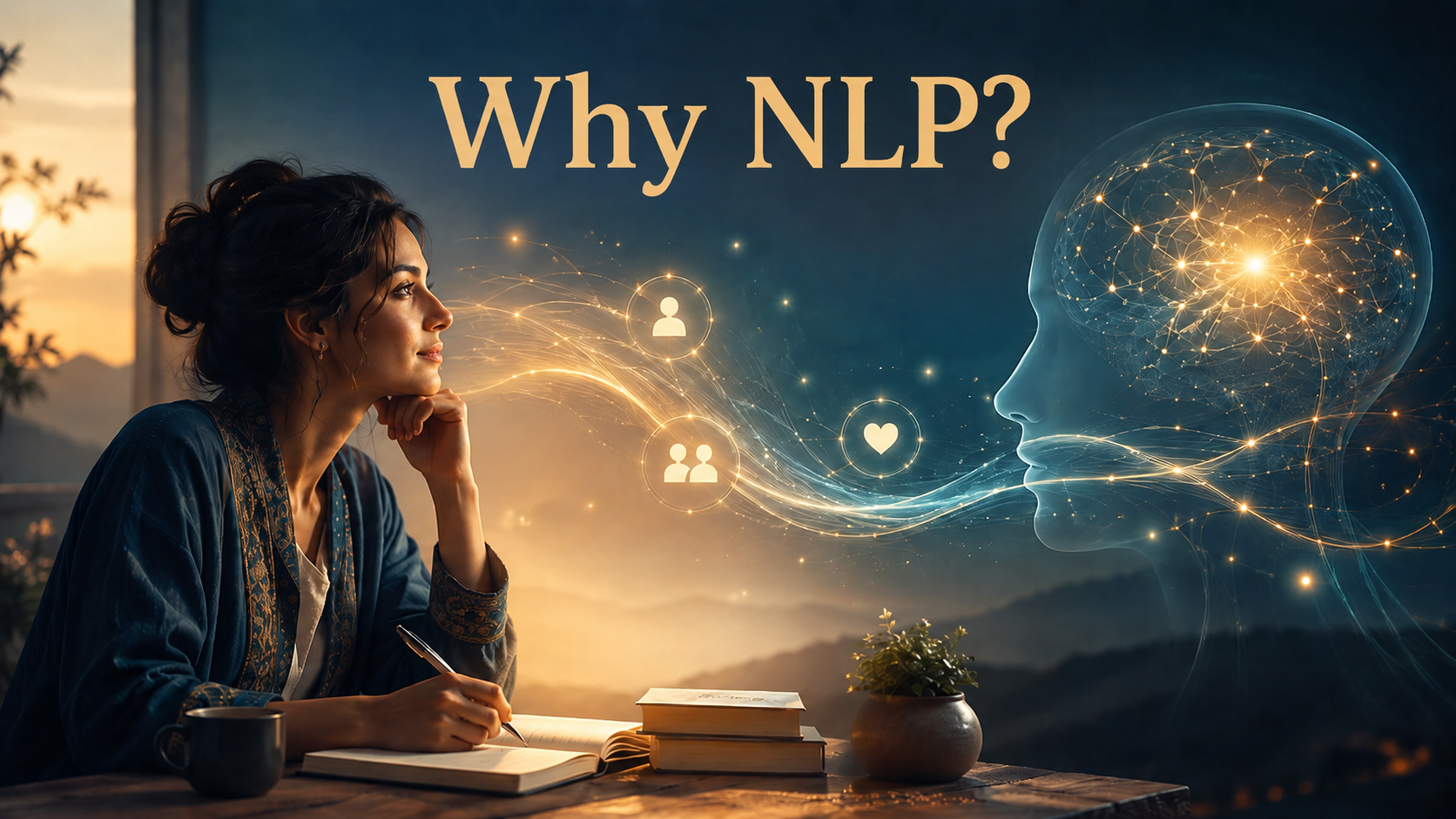
Why NLP?
Author: Soheila Dadkhah
NLP is not merely a collection of techniques for changing behavior or speaking better. If we look more deeply, NLP is a way of looking at human beings; a perspective that asks how people create their experiences, how they give meaning, how they make decisions, how they communicate, and how they can change limiting patterns.
At World Saromi Academy, we do not see NLP only as a set of educational tools. For us, NLP is a pathway to understanding the mind, language, emotions, behavior, and human communication more precisely. This approach helps us understand why different people react differently in similar situations, why certain beliefs limit a person’s life, how words can affect emotions and decisions, and how a new path in life and work can be created through awareness, practice, and the right method.
For this reason, NLP courses are suitable for people who are not only looking to learn techniques. They are for those who want to understand themselves, others, relationships, decisions, and their path of growth more deeply. This understanding can influence personal life, relationships, coaching, education, management, therapy, sales, leadership, parenting, content creation, and even the path of educational entrepreneurship.
The philosophy of NLP is based on the idea that human experience is not created directly from external reality alone. It is shaped by perception, interpretation, language, mental images, emotions, beliefs, and inner patterns. In simple terms, we do not experience the world only as it is; we experience it through our mental, emotional, linguistic, and experiential filters.
For example, two people may be in the same situation. One person may see it as a threat, while another may see it as an opportunity. One person may feel worthless after a failure, while another may see it as a learning experience. The difference between these two people is not only in the external event, but in the way that event is processed in their mind, language, and emotions.
NLP seeks to make these processes more visible, more understandable, and more changeable. In other words, it helps us understand how human beings create experience within themselves and how they can create a different experience of themselves and life by changing language, mental images, attention, beliefs, emotional states, and behavioral patterns.
From this perspective, a human being is not fixed or closed. A person can learn, change, create new patterns, extract new meanings from past experiences, and design the future more consciously. This is one of the reasons NLP has become so practical in education, coaching, personal development, communication, and professional work with people.
NLP is built on a set of presuppositions. A presupposition is not an absolute or unquestionable law; rather, it is a practical way of looking at human beings and change. These presuppositions help us become more flexible, precise, and effective in our relationship with ourselves and others.
One of the most well-known NLP presuppositions is: The map is not the territory. This means that our perception of reality is not reality itself. Every person creates a map of the world based on their experiences, beliefs, language, culture, memories, fears, and values. When we understand this, we are less likely to insist that only our view is correct, and more willing to understand the inner world of others.
Another important presupposition is that every behavior has a purpose or intention at some level. This does not mean approving every behavior. It means that behind many human behaviors, there may be a need, a fear, an attempt to protect oneself, a search for attention, safety, love, control, or survival. When we look beyond quick judgment and see the intention or need behind behavior, deeper and more human change becomes possible.
Another key NLP presupposition is that people have the resources they need for change within themselves, or they can develop them. Sometimes a person has forgotten that they are capable. Sometimes their resources are not active. Sometimes they are stuck in the past, or they do not know how to access their abilities. NLP helps these resources become visible, active, and practically available in life.
One of the powerful perspectives in NLP is that failure is not the end of the path; it is feedback for adjusting the path. This sentence may sound simple, but if it truly enters a person’s life, it can change the way they make decisions, learn, and grow.
Many people quickly judge themselves when they do not get the result they wanted. They say, “I can’t do this,” “I am not enough,” “I always mess things up,” or “This path is not for me.” NLP suggests that instead of labeling ourselves as failures, we ask: What did this experience show me? Which method did not work? What needs to change? What can I do differently next time?
This perspective is very important in education, coaching, management, entrepreneurship, and personal growth. No professional path is built without mistakes, experience, correction, and learning. If a person uses every result only to judge themselves, they gradually stop moving. But if they use results as feedback, the path of growth remains open.
In NLP courses, participants learn to build a new relationship with their experiences. Instead of escaping mistakes, they analyze them. Instead of blaming themselves, they see the pattern. Instead of stopping, they adjust the path. This is one of the skills that can deeply affect both personal and professional life.
In NLP, it is said that the meaning of communication is the response we receive. This means that communication is not only what we intended to say; it is also what the other person received, interpreted, and felt.
Many misunderstandings begin here. We think that because we had good intentions, our communication must have been delivered correctly. But in reality, tone of voice, words, body language, timing, emotional state, or the other person’s past experience may cause our message to be received differently.
This presupposition helps us communicate more responsibly. Instead of saying, “I did not mean anything bad,” we can ask, “How was my message received?” “What caused the misunderstanding?” “How can I communicate more clearly, respectfully, and effectively?”
This perspective is valuable for parents, couples, managers, teachers, therapists, coaches, sales professionals, speakers, and anyone who works with people. The quality of our life and work depends greatly on the quality of our communication. NLP helps us understand communication not merely as speaking, but as a living, two-way, and learnable process.
Participating in NLP courses can bring different benefits to each person depending on their goals and life path. Some people use these courses for personal growth. Some use them to improve relationships. Others use them for professional work, education, coaching, management, or leadership.
One of the most important benefits of NLP is increasing self-awareness. A person learns to better recognize their mental, emotional, linguistic, and behavioral patterns. Many of us live for years with patterns we are not even aware of. We may always delay decisions, repeat the same pattern in relationships, react similarly under emotional pressure, or live with a limiting inner dialogue. NLP helps make these patterns clearer.
Another benefit is improving effective communication. Participants learn how to listen better, ask more precise questions, communicate their message more clearly, understand body language and tone more deeply, and build relationships based on trust. These skills are highly practical in everyday life, family, work, education, and leadership.
NLP can also help a person define goals more precisely, recognize mental obstacles, manage emotional states, and build a more practical plan for change. This means NLP is not only about thinking; it is also about movement, choice, and conscious action.
In personal life, NLP can help us build a healthier relationship with ourselves. Many of our problems do not only come from the outside. Sometimes they come from our inner dialogue, old beliefs, self-image, and the meanings we have given to past experiences.
When a person participates in an NLP course, they learn to look at their inner experiences more carefully. They begin to notice how certain memories still affect today’s decisions, how certain words create specific feelings in the mind, how the body reacts to certain situations, and how they can relate to themselves more consciously.
This awareness can help with better emotional management. For example, a person learns that when they feel anxious, angry, disappointed, or confused, they do not have to drown in the emotion. They can recognize it, name it, observe its pattern, and find a healthier way to respond.
NLP can also support decision-making, self-confidence, goal-setting, habit change, rebuilding motivation, and moving beyond repeated patterns. For this reason, even people who do not intend to become coaches, trainers, or therapists can use these courses for their personal growth.
One of the strongest applications of NLP is in the field of communication. As human beings, we live through language. We think with words, express our emotions with words, build relationships with words, create misunderstandings with words, build trust with words, and sometimes create distance with words.
NLP shows us that language is not only a tool for transferring information; language can create experience. A sentence can calm someone or hurt them. A question can open the mind or close it. A tone of voice can create safety or defensiveness. When we understand this, we use words more responsibly.
In NLP courses, participants learn how to build more effective communication. This includes active listening, attention to body language, recognizing language patterns, building trust-based relationships, asking precise questions, identifying the need behind words, and creating a healthier space for dialogue.
These skills are very important for couples, parents, managers, teachers, counselors, therapists, sales professionals, speakers, and trainers. Whatever role we are in, the quality of our communication can change the quality of our results.
For those working in coaching, education, counseling, therapy, management, or personal development, NLP can be a highly practical tool. These fields all involve human beings, meaning, change, motivation, decisions, and communication.
With the help of NLP, a coach can better understand how a client creates their goals, which beliefs limit them, which inner resources are not active, and how the path forward can become clearer. A trainer can use NLP principles to create a better learning environment, communicate concepts more simply, and connect with different learning styles.
In management and leadership, NLP can also support better team understanding, more effective communication, conflict resolution, motivation, pressure management, and more conscious decision-making. Managers who understand human language, emotions, beliefs, and communication patterns more deeply can often create a more human and effective organizational environment.
In professional work with people, having information is not enough. A person must be able to listen, ask questions, recognize patterns, create space, support change, and work respectfully with people’s inner worlds. NLP offers valuable frameworks and tools for this kind of work.
At World Saromi Academy, we chose NLP because this approach creates a practical bridge between mind, language, emotion, behavior, and communication. NLP helps us avoid seeing human beings from only one angle. A human being is not only thought, not only emotion, not only behavior, and not only words. A human being is a living combination of experiences, meanings, beliefs, body, language, relationships, and choices.
We chose NLP because it is a practical approach. It does not only talk about change; it helps a person experience, practice, and apply the path of change. In this process, participants are not only listeners. They take part in exercises, conversations, individual and group experiences, and educational processes.
We chose NLP because it values human communication. In a world where many relationships have become superficial, rushed, or full of misunderstanding, learning deeper communication skills is essential. NLP reminds us that behind every word, there is a human being with experiences, fears, hopes, needs, and meanings.
We also chose NLP because it can support people’s professional paths. Someone who learns NLP deeply and according to standards can use it in coaching, education, management, communication, personal development, content creation, public speaking, workshops, and even entrepreneurship.
At World Saromi Academy, NLP education is not only about transferring techniques. We believe that technique without understanding becomes superficial, and understanding without practice does not enter real life. For this reason, NLP courses must include structure, experience, practice, dialogue, and assessment.
From this perspective, participants should have the opportunity not only to hear concepts, but also to experience them. They should be able to ask questions, practice, receive feedback, see themselves in more realistic situations, and gradually develop their skills.
We see NLP as a path for understanding human beings, conscious communication, responsible change, and professional growth. For this reason, these courses are designed for people who want to take learning seriously and turn it into part of their life, work, or professional path.
In this path, professional ethics are very important. Any knowledge that works with human beings must be accompanied by respect, responsibility, clear boundaries, and honesty. NLP becomes valuable when it serves growth, awareness, choice, and healthier communication.
NLP is useful for a wide range of people, but some groups can benefit from it especially deeply. People who work with human beings often need NLP skills more, because their work is not only about tasks and information. It also involves emotions, communication, decisions, and human meanings.
Trainers, coaches, therapists, counselors, teachers, managers, parents, speakers, sales professionals, content creators, artists, writers, and cultural activists can use NLP to improve the quality of their work. Each of these people deals in some way with language, influence, listening, guidance, education, or change.
People who are in a stage of personal change can also benefit from NLP. Someone who wants to change their career path, build more self-confidence, create healthier relationships, define clearer goals, or move beyond repeated patterns can find useful tools in this approach.
Ultimately, NLP is suitable for people who are committed to their own growth. Not those who are only looking for quick answers, but those who are willing to understand themselves, practice, receive feedback, and make more responsible choices.
For us, NLP is a deep and practical educational path: a path for better understanding human beings, building more effective communication, changing limiting patterns, and moving toward conscious growth. The philosophy of NLP reminds us that human beings are not only the product of external events. Through changes in meaning, language, attention, belief, and behavior, they can create a new experience of themselves and life.
NLP presuppositions help us relate to ourselves and others in a more human, flexible, and precise way. When we understand that each person’s map is different from another’s, our communication becomes calmer and deeper. When we see failure as feedback, the path of learning remains open. When we see the meaning of communication in the response we receive, we speak more responsibly and listen better.
Participating in NLP courses can be highly effective for personal growth, communication, coaching, education, management, leadership, and professional development. For this reason, World Saromi Academy has chosen NLP as one of its main educational pathways, because this approach can help people understand themselves better, connect more deeply with others, and build their life and work path more consciously.
Bandler, R., & Grinder, J. (1975). The Structure of Magic I: A Book About Language and Therapy. Science and Behavior Books.
Bandler, R., & Grinder, J. (1976). The Structure of Magic II: A Book About Communication and Change. Science and Behavior Books.
Bandler, R., & Grinder, J. (1979). Frogs into Princes: Neuro Linguistic Programming. Real People Press.
Dilts, R. B. (1983). Applications of Neuro-Linguistic Programming. Meta Publications.
Dilts, R. B. (1998). Modeling with NLP. Meta Publications.
Dilts, R. B. (1999). Sleight of Mouth: The Magic of Conversational Belief Change. Meta Publications.
Dilts, R. B., Grinder, J., Bandler, R., & DeLozier, J. (1980). Neuro-Linguistic Programming: Volume I: The Study of the Structure of Subjective Experience. Meta Publications.
Knight, S. (2002). NLP at Work: The Difference That Makes the Difference in Business. Nicholas Brealey Publishing.
McDermott, I., & Jago, W. (2001). The NLP Coach: A Comprehensive Guide to Personal Well-Being and Professional Success. Piatkus.
O’Connor, J., & Seymour, J. (1990). Introducing Neuro-Linguistic Programming: Psychological Skills for Understanding and Influencing People. Thorsons.
Ready, R., & Burton, K. (2010). Neuro-Linguistic Programming For Dummies. Wiley.
Tosey, P., & Mathison, J. (2009). Neuro-Linguistic Programming: A Critical Appreciation for Managers and Developers. Palgrave Macmillan.
International Association of NLP Institutes, IN. Official Website:
https://www.nlp-institutes.net/
International Association of NLP Institutes, IN. Trainer Profile Page:
https://www.nlp-institutes.net/soheila-dadkhahَ
Explore books by Soheila Dadkhah (Seromi), from Segva and Ishkar to Luma. Compare themes, reading styles and available PDF, print and retailer editions.
Explore Seromi’s proposed seven-stage framework for examining needs and coping strategies, with NLP Plus exercises, examples and discussion of limitations.
Explore “need viruses” as a Seromi metaphor for learned patterns linking natural needs, interpretations and coping strategies, with everyday examples.