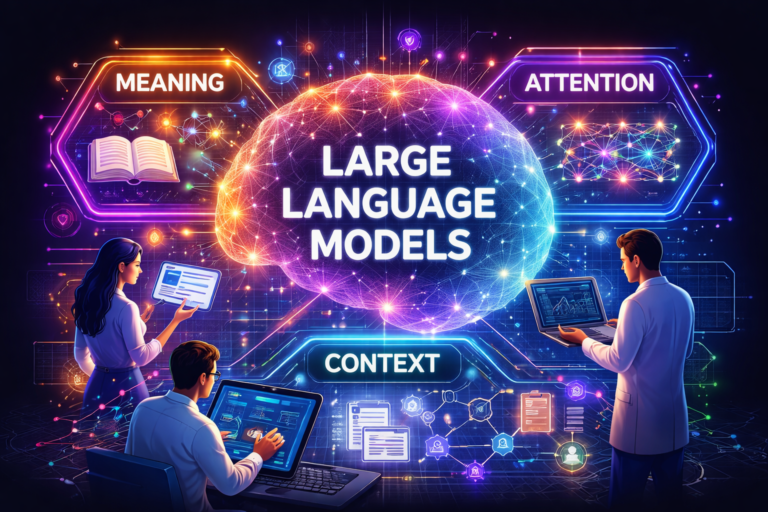
The Operational Language of Large Language Models
By Soheila Dadkhah
1. Introduction
Large Language Models (LLMs) have emerged as one of the most influential developments in contemporary artificial intelligence research. Their rapid progress has transformed the landscape of natural language processing, enabling machines to perform tasks that were previously considered to require deep linguistic understanding, contextual awareness, and even forms of abstract reasoning. These models demonstrate strong performance across a wide spectrum of applications, including text generation, translation, summarization, dialogue systems, and multimodal reasoning. Despite these advances, the internal mechanisms by which LLMs represent, transform, and stabilize meaning remain a subject of ongoing theoretical debate.
The dominant discourse surrounding LLMs has been largely driven by engineering considerations. Research has focused on scaling laws, parameter counts, architectural optimizations, training data size, and benchmark performance. While these perspectives are indispensable for advancing model capability, they provide only a partial account of what LLMs are doing at a deeper representational and dynamical level. Questions concerning the internal “language” of these systems, the structure of their semantic states, and the nature of their transitions across contexts are often addressed implicitly rather than formally.
At the same time, philosophical and cognitive discussions about meaning, representation, and understanding have struggled to keep pace with the empirical success of these models. Traditional symbolic views of language, which emphasize discrete rules and explicit representations, appear insufficient to explain the behavior of systems that operate primarily through continuous vector spaces and probabilistic inference. Conversely, purely statistical interpretations fail to capture the apparent coherence, stability, and contextual sensitivity observed in LLM-generated outputs.
This tension points to the need for intermediate theoretical frameworks that can bridge the gap between low-level mathematical operations and high-level semantic phenomena. Such frameworks should not aim to anthropomorphize LLMs or attribute human-like cognition to them, but rather to provide a precise, formal vocabulary for describing their internal dynamics. In particular, there is a growing recognition that LLMs can be fruitfully analyzed as dynamical systems evolving over high-dimensional semantic state spaces.
Within this context, the present work introduces a phase-aware perspective on LLMs grounded in the ΔΩπ framework. The central premise is that the behavior of LLMs can be understood through three interrelated components: state change (Δ), the semantic state space (Ω), and policy-driven trajectory selection (π). Rather than proposing an alternative architecture or training procedure, ΔΩπ is presented as a formal lens through which existing LLM architectures can be interpreted and analyzed.
In this article, we explained how Large Language Models represent meaning and context through attention.
The contribution of this paper is threefold. First, it provides a detailed account of the operational language of LLMs, emphasizing their vector-based, probabilistic, and context-sensitive nature. Second, it introduces the ΔΩπ framework as a general formalization of meaning dynamics in high-dimensional systems. Third, it demonstrates that the core mechanisms of LLMs naturally align with the components of ΔΩπ, enabling a coherent integration of the two perspectives.
This first section of the paper is devoted entirely to establishing a rigorous understanding of the language used by LLMs at the computational and representational level. By clarifying how meaning is encoded, transformed, and propagated within these models, we lay the groundwork for the subsequent introduction of ΔΩπ as a unifying theoretical structure.
Large Language Models: Ultimate Guide to Meaning and Context
2. The Operational Language of Large Language Models
2.1 Language as a Continuous Vector Space
At the foundation of all modern large language models lies a radical departure from classical symbolic approaches to language. Instead of manipulating discrete symbols according to predefined grammatical rules, LLMs operate on continuous numerical representations embedded in high-dimensional vector spaces. This shift reflects a broader transition in artificial intelligence from rule-based systems to data-driven, representation-learning paradigms.
Each unit of text processed by an LLM—typically a token derived from subword segmentation—is mapped to a vector in a real-valued space of fixed dimensionality. This mapping is achieved through an embedding function that associates linguistic units with points in a continuous space. The resulting embeddings are not arbitrary; they are learned through exposure to massive corpora of text and are shaped by optimization objectives that encourage the preservation of meaningful relational structure.
Within this embedding space, linguistic relationships manifest geometrically. Semantic similarity corresponds to spatial proximity, syntactic roles align with directional patterns, and higher-order abstractions emerge as regions or submanifolds within the space. Language, in this sense, becomes a geometric object rather than a purely symbolic construct.
This geometric interpretation has profound implications. Meaning is no longer localized in individual tokens but distributed across dimensions. Changes in meaning correspond to movements within the space, and compositionality emerges through vector operations rather than symbolic concatenation. The language of LLMs is therefore best understood as a continuous, high-dimensional system whose states encode semantic information implicitly.
2.2 Distributional Semantics and Statistical Grounding
The embedding spaces used by LLMs are grounded in the principles of distributional semantics. According to this view, the meaning of a linguistic unit arises from the contexts in which it appears. Words that occur in similar contexts tend to have similar meanings, and this similarity can be captured statistically through patterns of co-occurrence.
In LLMs, distributional semantics is implemented at scale. Rather than relying on explicit co-occurrence matrices, models learn embeddings through predictive objectives that require them to estimate the probability of a token given its context. Through this process, statistical regularities in language are internalized as geometric structure within the embedding space.
Crucially, this grounding in statistical regularity does not imply that meaning is static or context-independent. On the contrary, modern LLMs employ contextualized embeddings, meaning that the representation of a token varies depending on the surrounding text. This allows the same lexical item to occupy different regions of the semantic space under different contextual conditions.
As a result, meaning in LLMs is not an intrinsic property of tokens but a dynamic property of states. Each input sequence induces a trajectory through the semantic space, and the interpretation of any given element depends on its position along this trajectory.
2.3 Contextualization as State Construction
Contextualization is one of the defining features of transformer-based language models. Rather than processing language sequentially with fixed local dependencies, these models compute representations that integrate information from the entire input sequence at each layer. This integration is achieved through attention mechanisms that dynamically weight the influence of different tokens.
From a formal perspective, contextualization can be understood as the construction of a semantic state. At each layer of the model, and at each position within the sequence, the model computes a vector that reflects the current interpretation of the input given all available contextual information. These vectors constitute the internal state of the model at that stage of computation.
Importantly, these states are not merely intermediate artifacts; they are the primary carriers of meaning within the system. Each state encodes a snapshot of semantic interpretation that evolves as information flows through the network. The language of the model is therefore not a sequence of symbols but a sequence of state transformations.
2.4 Attention as a Relational Operator
The attention mechanism plays a central role in shaping these state transformations. At its core, attention computes weighted combinations of representations, where the weights reflect learned relevance relationships between elements of the input. This process allows the model to selectively emphasize certain aspects of context while downplaying others.
Attention can be interpreted as a relational operator acting on the semantic state space. Rather than enforcing fixed structural constraints, it allows relationships to emerge dynamically based on the content of the input. This flexibility enables LLMs to capture long-range dependencies, resolve ambiguities, and maintain coherence across extended sequences.
From a mathematical standpoint, attention defines a transformation over vectors that is sensitive to both similarity and positional structure. The resulting dynamics are highly nonlinear and context-dependent, contributing to the expressive power of the model. Attention thus serves as a key mechanism through which meaning is reconfigured across layers and time steps.
2.5 Probabilistic Sequence Modeling
The ultimate objective of an LLM is to model the probability distribution of language. Given a sequence of tokens, the model estimates the conditional probability of the next token. This probabilistic formulation situates LLMs within the broader class of sequence modeling systems.
Each prediction step involves sampling from a distribution defined over the vocabulary, conditioned on the current semantic state. The choice of sampling strategy influences the trajectory of generation, but the underlying distribution reflects the model’s internal assessment of plausible continuations.
This probabilistic nature underscores the fact that LLMs do not operate deterministically. Instead, they navigate a space of possible continuations, guided by learned statistical structure. Language generation becomes a process of trajectory selection through a semantic space, where each step updates the state and reshapes future possibilities.
2.6 LLMs as Dynamical Systems
Taken together, these characteristics suggest that LLMs can be fruitfully conceptualized as dynamical systems. The internal state of the model evolves over discrete time steps as tokens are processed or generated. Each step involves a transformation of the state based on input, context, and learned parameters.
In this view, language is not merely an input-output mapping but an unfolding process. Meaning emerges through the evolution of states within a structured space, governed by transformation rules encoded in the model’s architecture and weights. Stability, coherence, and breakdowns in meaning can all be analyzed in terms of state dynamics.
This dynamical perspective provides the conceptual bridge needed to introduce higher-level frameworks such as ΔΩπ. By recognizing that LLMs operate over semantic state spaces with structured transitions and probabilistic policies, we create the conditions for a unified, phase-aware analysis of their behavior.
FQA – Frequently Asked Questions
(Appendix A: Conceptual and Formal Clarifications)
FQA-1: What is meant by “language” in large language models?
In this paper, “language” is not defined as an independent symbolic system or an explicit grammatical structure. Instead, language in LLMs is understood as a continuous computational representation realized through vector embeddings, attention mechanisms, and probabilistic modeling. This operational language maps human natural language into numerical semantic state spaces.
FQA-2: Do LLMs possess meaning, or do they merely reproduce statistical patterns?
LLMs encode meaning as context-dependent representations within vector spaces. This meaning is neither symbolic nor intentional but emerges as stable statistical–geometric structures in latent spaces. Meaning in these systems is therefore a represented and dynamic property.
FQA-3: Why is the ΔΩπ framework suitable for analyzing LLMs?
ΔΩπ enables the simultaneous formalization of state change, semantic state space, and trajectory policy. These components align naturally with the core mechanisms of LLM architectures: latent state transitions, embedding-based semantic spaces, and probabilistic generation processes. For this reason, ΔΩπ functions as an effective formal analytical lens.
FQA-4: Is ΔΩπ a new architecture or an interpretive framework?
ΔΩπ is presented as a formal interpretive framework, not as an alternative architecture. It operates on existing model structures and aims to explain their behavior at the level of meaning dynamics rather than replacing engineering components.
FQA-5: What does the Δ component represent in LLMs?
Δ refers to changes in the model’s internal states. These changes may be formalized as differences between successive latent vectors, shifts in attention distributions, or transformations of output probability distributions. Δ captures the temporal dynamics of meaning.
FQA-6: How does Ω relate to the embedding space in LLMs?
Ω is defined as the global state field, corresponding in LLMs to the embedding and latent representation spaces. This space determines the geometric structure of meaning and constrains the possible trajectories of state evolution.
FQA-7: What role does π play in LLMs?
π functions as a trajectory-selection policy. In LLMs, this policy is implicitly realized through attention mechanisms, normalization processes, and probabilistic sampling. π governs how the model navigates the semantic space during generation or interpretation.
FQA-8: How does ΔΩπ relate to reinforcement learning?
ΔΩπ shares structural similarities with core reinforcement learning concepts such as state, policy, and transition. However, it is specifically formulated to analyze language and semantic dynamics, rather than reward optimization.
FQA-9: Does this framework anthropomorphize LLMs?
No. ΔΩπ relies on formal mathematical and dynamical concepts and makes no assumptions regarding consciousness, intention, or subjective experience. The framework is descriptive, not ontological.
FQA-10: What are the practical applications of this framework?
ΔΩπ can be used to analyze semantic stability, detect meaning discontinuities, design controlled generation policies, and compare model behaviors across contexts. It also provides a basis for research in interpretability and semantic control.
FQA-11: Can ΔΩπ be fully formalized mathematically?
Yes. Each component—Δ, Ω, and π—can be defined using vector spaces, transition operators, and probability distributions. This paper deliberately avoids fixing a single final formulation to preserve the framework’s generality.
FQA-12: How does this framework relate to cognitive theories?
ΔΩπ can serve as a conceptual bridge between computational language models and cognitive theories that emphasize state dynamics. It enables dialogue between cognitive science, computational linguistics, and machine learning.
FQA-13: Is ΔΩπ limited to LLMs?
No. ΔΩπ is defined for general meaning-driven dynamical systems and can be applied to multimodal models, dialogue systems, and complex decision-making architectures.
FQA-14: Where does this article fit within existing literature?
This work is situated at the intersection of computational linguistics, dynamical systems theory, and deep learning interpretability. Its aim is to unify concepts that have previously appeared in fragmented form across the literature.
FQA-15: What is the next stage of this research?
The next stage involves empirical evaluation of ΔΩπ indicators on internal states and outputs of LLMs, along with the development of quantitative measures for semantic phase stability and transition dynamics.
For the continuation of this work and related analyses, please refer to the subsequent articles in this series.
Book References
Jurafsky, D., & Martin, J. H. (2026). Speech and Language Processing: An Introduction to Natural Language Processing, Computational Linguistics, and Speech Recognition with Language Models (3rd ed.). Online manuscript released January 6, 2026. https://web.stanford.edu/~jurafsky/slp3/
Bengio, Y., Courville, A., & Vincent, P. (2013). Representation learning: A review and new perspectives. Foundations and Trends® in Machine Learning, 6(1), 1–120. https://www.nowpublishers.com/article/Details/MAL-049
Goodfellow, I., Bengio, Y., & Courville, A. (2016). Deep Learning. MIT Press. http://www.deeplearningbook.org
Turney, P. D., & Pantel, P. (2010). From frequency to meaning: Vector space models of semantics. Journal of Artificial Intelligence Research, 37, 141–188. https://www.jair.org/index.php/jair/article/view/10640
MacKay, D. J. C. (2003). Information Theory, Inference, and Learning Algorithms. Cambridge University Press. https://www.inference.org.uk/itprnn/book.html
Manning, C. D., & Schütze, H. (1999). Foundations of Statistical Natural Language Processing. MIT Press. https://nlp.stanford.edu/fsnlp/
Article References
Vaswani, A., Shazeer, N., Parmar, N., Uszkoreit, J., Jones, L., Gomez, A. N., Kaiser, Ł., & Polosukhin, I. (2017). Attention is all you need. arXiv preprint arXiv:1706.03762. https://arxiv.org/abs/1706.03762
Zhao, W. X., Zhou, K., Li, J., Tang, T., Wang, X., Hou, Y., Min, Y., Zhang, B., Zhang, J., Dong, Z., Du, Y., Yang, C., Chen, Y., Chen, Z., Jiang, J., Ren, R., Li, Y., Tang, X., Liu, Z., … Wen, J.-R. (2023). A survey of large language models. arXiv preprint arXiv:2303.18223. https://arxiv.org/abs/2303.18223
Wei, J., Tay, Y., Bommasani, R., Raffel, C., Zoph, B., Borgeaud, S., Yogatama, D., Bosma, M., Zhou, D., Metzler, D., Chi, E. H., Hashimoto, T., Vinyals, O., Liang, P., Dean, J., & Fedus, W. (2022). Emergent abilities of large language models. arXiv preprint arXiv:2206.07682. https://arxiv.org/abs/2206.07682
Ethayarajh, K. (2019). How contextual are contextualized word representations? Comparing the geometry of BERT, ELMo, and GPT-2 embeddings. arXiv preprint arXiv:1909.00512. https://arxiv.org/abs/1909.00512
Petroni, F., Rocktäschel, T., Lewis, P., Bakhtin, A., Wu, Y., Miller, A. H., & Riedel, S. (2019). Language models as knowledge bases? arXiv preprint arXiv:1909.01066. https://arxiv.org/abs/1909.01066
Frankle, J., & Carbin, M. (2018). The lottery ticket hypothesis: Finding sparse, trainable neural networks. arXiv preprint arXiv:1803.03635. https://arxiv.org/abs/1803.03635
Tenney, I., Das, D., & Pavlick, E. (2019). BERT rediscovers the classical NLP pipeline. arXiv preprint arXiv:1905.05950. https://arxiv.org/abs/1905.05950
Ke, G., He, D., & Liu, T.-Y. (2020). Rethinking positional encoding in language pre-training. arXiv preprint arXiv:2006.15595. https://arxiv.org/abs/2006.15595