

NLP
Human Needs and Their Viruses.Part3
Part Three: Reconstructing Distorted Needs Using NLP Plus Techniques Author:
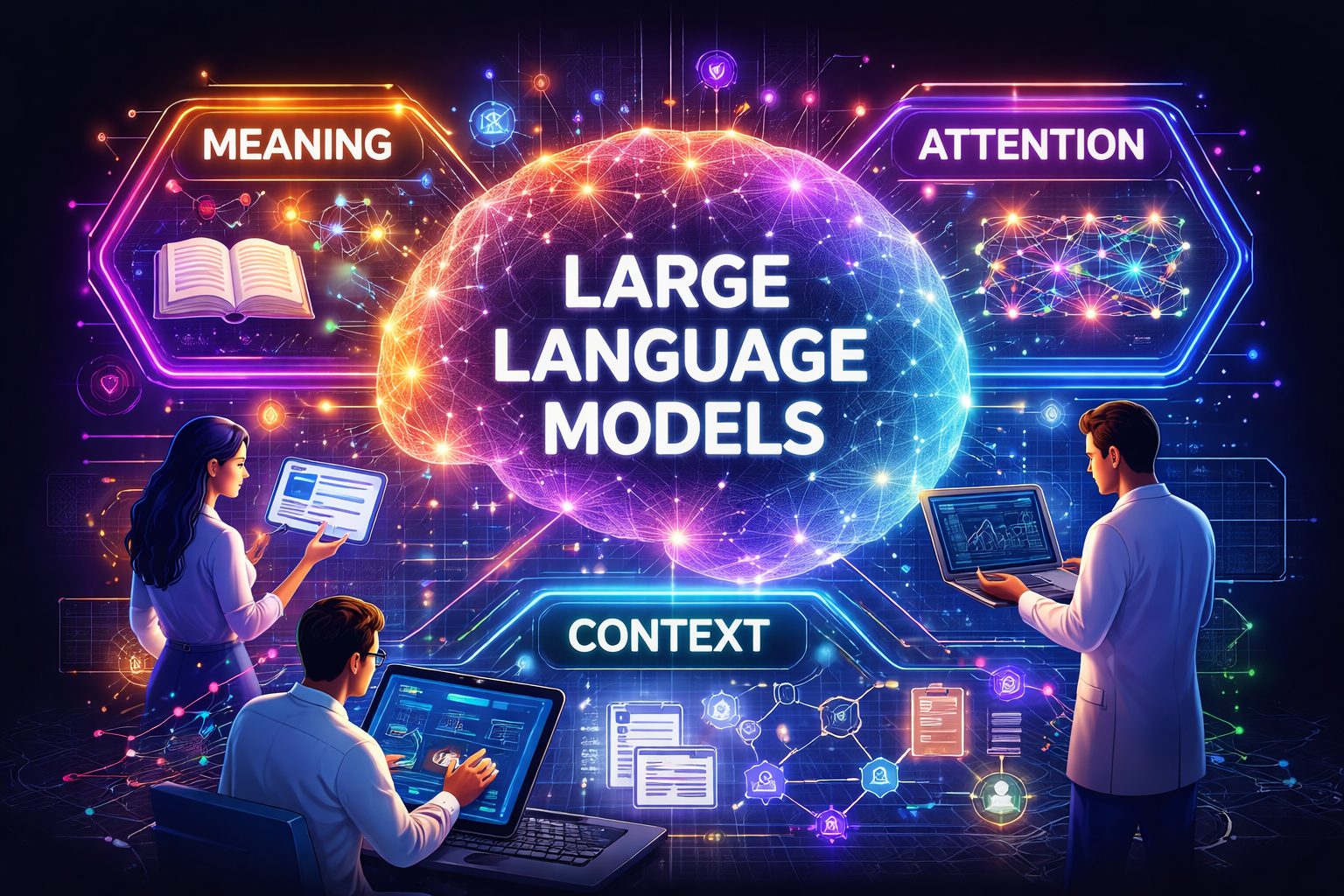
Effective Human AI Interaction determines how meaning and attention remain stable across complex multi-turn exchanges.
By Soheila Dadkhah
Human AI Interaction is a central factor in how large language models generate meaning, manage context, and align attention in real-world use.
Large Language Models (LLMs) have moved beyond their original role as text-processing tools. In practice, they now function as conversational partners, decision-support systems, and engines of knowledge production across a wide range of human activities.
This shift brings the central question of Part 2 into focus: the quality of LLM outputs is not determined solely by model architecture or training data; it is also substantially shaped by the quality of the interactive relationship between humans and intelligent systems.
In this relationship, humans configure meaning through language, structure, and context, while models extend that meaning through mechanisms of attention and probabilistic generation.
Official research published by OpenAI in 2025 demonstrates that hallucination is not a random failure mode but a systemic outcome of current training and evaluation regimes.
These regimes often reward confident guessing while under-incentivizing the explicit expression of uncertainty. As a result, even highly capable models tend to produce confident but incorrect outputs in situations of ambiguity (OpenAI, Why Language Models Hallucinate, 2025).
In the same line, the official System Card for the o3 and o4-mini models (OpenAI, April 2025) reports concrete hallucination rates on standardized evaluations such as SimpleQA and PersonQA. For example, hallucination rates on SimpleQA are reported as 0.51 for o3 and 0.79 for o4-mini, while on PersonQA they reach 0.33 and 0.48 respectively.
These figures establish a critical point: increasing model capability alone does not automatically eliminate error; hallucination is also contingent on evaluation design, contextual framing, and interaction structure.
At the same time, applied and clinical research shows that scenario design and prompting strategies can substantially alter error rates.
A multi-model analysis published in Nature (2025) reports an average hallucination rate of approximately 65.9% under default prompting conditions, which was reduced to about 44.2% through the use of a structured, hallucination-mitigating prompt.
This finding sharpens the practical premise of Part 2: interaction is not a cosmetic layer applied to a model; it is a determinant component of real-world performance.
Parallel developments in Human–Computer Interaction (HCI) and multi-agent systems research indicate that human–AI interaction is evolving from single-model dialogue toward agent-based collaboration. In these architectures, supervisory or coordinating agents manage multiple specialized agents, while humans assume the role of goal-setters and evaluators of success criteria.
This research trajectory is documented in recent ACM publications on multi-agent architectures and interaction design.
Workshop reports within the HCI research community further confirm a disciplinary shift away from purely instrumental use of LLMs toward interactive and agent-oriented roles, where relational dynamics and coordination become central design concerns.
Human AI Interaction plays a central role in how large language models generate meaning and manage context across real-world applications.
https://seromi.net/category/articles/
Purpose of Part 2
This section proposes a framework that treats human–AI interaction as a measurable system. Within this system, humans act as sources of context and evaluative criteria; models function as engines of attention and generation; and the interaction itself forms a feedback loop that amplifies or degrades output quality.
The aim is to transform interaction from an intuitive or informal skill into a practical protocol—repeatable, operationalizable, and evaluable through explicit metrics.
Operational Definition of Human–AI Interaction in This Article
Human AI Interaction and Context Alignment
In this article, effective interaction is defined as a state characterized by three simultaneous properties:
Chapter Roadmap for Part 2
Building on this framework, Part 2 analyzes the components of human–AI interaction as discrete, actionable elements:
This introduction completes the conceptual foundation of Part 2: human–AI interaction is an engineerable system; outputs depend directly on how this system is designed; and contemporary scientific literature (2025) supports this claim with formal evaluations, empirical data, and institutional reports.
2. Empirical Trends in Human–LLM Interaction Quality
Early evaluation of Large Language Models focused almost exclusively on model-internal performance: benchmark accuracy, perplexity reduction, and task completion under static prompts.
Over the last three years, this focus has shifted toward interaction-centric evaluation, driven by evidence that output quality varies significantly under different human interaction patterns.
Research communities in Human–Computer Interaction (HCI), computational linguistics, and applied AI have converged on a shared observation: identical models can exhibit markedly different error rates, coherence levels, and task success depending on how humans structure inputs, manage context, and provide feedback.
This shift is documented in ACM HCI workshop reports (2024–2025), which explicitly argue that LLM behavior must be studied as part of a joint human–AI system, rather than as an isolated algorithmic component.
This reframing aligns with distributed cognition theory, where cognitive outcomes emerge from interactions between agents rather than from a single processing unit.
In the context of LLMs, meaning production becomes a co-regulated process, shaped jointly by human linguistic behavior and model attention dynamics.
Effective Human AI Interaction determines how meaning and attention remain stable across complex multi-turn exchanges.
Empirical studies presented at ACL and IJCAI conferences (2024–2025) show that users systematically adapt their communication strategies when interacting with LLMs. Observed adaptations include:
These adaptations are not incidental. OpenReview-published experimental work demonstrates that humans learn, through interaction, how to “steer” model outputs more effectively, resulting in higher task success and lower semantic drift over time.
This indicates the presence of a dynamic interaction loop, in which both sides of the system—human and model—contribute to stabilization of meaning.
Importantly, this adaptation does not require changes to model parameters. It occurs entirely at the level of interaction, reinforcing the claim that interaction quality is an independent variable influencing performance.
Human AI Interaction directly affects how attention mechanisms respond to context and constraints during multi-turn reasoning.
The question of whether interaction quality has measurably improved model reliability requires careful qualification. There is no single global hallucination rate; error prevalence depends on task type, evaluation design, and interaction structure.
OpenAI’s 2025 system evaluations provide a rare source of standardized, quantitative data. The System Card for o3 and o4-mini reports hallucination rates across controlled benchmarks such as SimpleQA and PersonQA. These evaluations show that:
Parallel findings in biomedical and clinical domains reinforce this picture.
A 2025 Nature study reports hallucination rates exceeding 60% under default prompting in high-stakes medical question answering, with reductions of over 20 percentage points achieved through structured, constraint-aware prompts.
This demonstrates that interaction design alone can produce statistically significant reliability gains, without altering model architecture.
Taken together, these findings indicate that overall error rates have not uniformly declined across all use cases. Instead, reliability has become interaction-dependent: improved in structured, well-scaffolded scenarios, and persistently high in open-ended or underspecified ones.
A major development influencing interaction quality is the rise of agent-based and multi-agent LLM systems.
Research presented at IJCAI and documented in ACL Findings (2025) describes architectures in which LLMs interact with internal tools, memory modules, or other specialized agents under a coordinating framework.
In these systems, humans no longer interact with a single conversational entity but with a layered interaction environment, where:
Studies evaluating these architectures report improved task completion rates and reduced coordination errors compared to single-agent baselines.
However, they also note that human role clarity—explicit goal definition, boundary setting, and evaluation criteria—is critical. When human input is poorly structured, multi-agent systems can amplify rather than mitigate error.
This reinforces a central conclusion of this article: increased system complexity does not substitute for high-quality human interaction; it raises the interaction requirements.
Based on the current body of evidence, the answer is nuanced but precise:
The dominant trend is not a simple reduction in model error, but a redistribution of responsibility: reliability increasingly emerges from the human–AI interaction system rather than from the model alone.
This empirical reality sets the stage for the next sections of Part 2, which examine how humans can systematically act as context-setters, attention aligners, and error regulators within this joint system—transforming interaction from an ad hoc skill into a reproducible cognitive practice.
FAQ –Human AI Interaction directly affects how attention mechanisms respond to context and constraints during multi-turn reasoning. Human–AI Interaction and Reliability
Improved interaction does not eliminate model limitations, but it systematically constrains their impact. Empirical evidence shows that structured inputs, explicit context setting, and feedback loops can significantly reduce hallucination rates and semantic drift without modifying model parameters. Interaction quality acts as a control layer over probabilistic generation, shaping how uncertainty manifests rather than removing uncertainty itself.
Hallucination is a system-level phenomenon, not exclusively a model failure. Model architectures and training objectives create the conditions for hallucination, but interaction design determines how often and how severely it appears in practice. Studies comparing default prompting with constrained or guided prompting demonstrate large variance in error rates, indicating that interaction plays a causal—not merely cosmetic—role.
More capable models often generate longer, more confident outputs, which increases exposure to unsupported claims when uncertainty is present. Evaluation regimes frequently reward fluency and completeness over calibrated uncertainty. Without interaction structures that explicitly allow or encourage uncertainty signaling, higher capability can translate into higher apparent hallucination under certain benchmarks.
Multi-agent systems improve reliability only when human roles are clearly defined. Research shows gains in task completion and error detection when agents cross-check each other under structured supervision. However, when goals, constraints, or evaluation criteria are underspecified by humans, multi-agent architectures can amplify error propagation rather than mitigate it. System complexity raises, rather than removes, the need for precise human interaction.
It means defining interaction in terms of repeatable procedures rather than individual intuition. This includes consistent methods for setting context, encoding intent, managing attention across turns, and correcting errors. When these elements are formalized, interaction quality becomes measurable and transferable across users and domains, enabling reliability to emerge from the joint system rather than from individual expertise alone.
References
Human-Centered Artificial Intelligence. Ben Shneiderman. Oxford University Press.
https://hcil.umd.edu/human-centered-ai/
Human-Centered Artificial Intelligence: Research and Applications. Elsevier.
https://shop.elsevier.com/books/human-centered-artificial-intelligence/nam/978-0-323-85648-5
Human-AI Interaction and Collaboration. Cambridge University Press.
https://www.cambridge.org/core/books/humanai-interaction-and-collaboration/CC47EFB06171F714256FD11EFE38DC16
Human-Centered AI: A Multidisciplinary Perspective for Policy Makers, Auditors, and Users. Routledge.
https://www.routledge.com/Human-Centered-AI-A-Multidisciplinary-Perspective-for-Policy-Makers-Auditors-and-Users/Regis-Denis-Axente-Kishimoto/p/book/9781032341613
The Alignment Problem: Machine Learning and Human Values. Brian Christian. W. W. Norton & Company.
https://wwnorton.com/books/The-Alignment-Problem/
Human Compatible: Artificial Intelligence and the Problem of Control. Stuart Russell. Viking.
https://www.penguinrandomhouse.com/books/566677/human-compatible-by-stuart-russell/
Human + Machine: Reimagining Work in the Age of AI. Paul R. Daugherty & H. James Wilson. Harvard Business Review Press.
https://store.hbr.org/product/human-machine/10192
Artificial Knowing: Gender and the Thinking Machine. Alison Adam. Routledge.
https://www.routledge.com/Artificial-Knowing/Adam/p/book/9780415158919
Designing Human-Centric AI Experiences. Akshay Khot. Packt Publishing.
https://www.packtpub.com/product/designing-human-centric-ai-experiences/9781803233243
Handbook of Human-Centered Artificial Intelligence. Springer.
https://link.springer.com/book/10.1007/978-981-97-8440-0
Hallucination Rates and Reference Accuracy of ChatGPT and Bard for Systematic Reviews: Comparative Analysis — Journal of Medical Internet Research (JMIR), 2024.
https://www.jmir.org/2024/1/e53164/
EvalLM: Interactive Evaluation of Large Language Model Prompts on User-Defined Criteria — CHI 2024, Proceedings of the ACM Conference on Human Factors in Computing Systems.
https://dl.acm.org/doi/10.1145/3613904.3642216
EvalLM (ArXiv preprint version) — Interactive Evaluation of Large Language Model Prompts on User-Defined Criteria (archive version).
https://arxiv.org/abs/2309.13633
HalluLens: LLM Hallucination Benchmark — ACL 2025 (Long Papers, Association for Computational Linguistics).
https://aclanthology.org/2025.acl-long.1176/
Part Three: Reconstructing Distorted Needs Using NLP Plus Techniques Author:
Part One: Defining Natural Human Needs Author: Soheila Dadkhah Abstract